© 2026 Casey Spitnale
Conclusion
Seeing God in the Sting
“Some have said that honeybees are messengers sent by the gods to show us how we ought to live: in sweetness and in beauty and in peacefulness.”
The conclusion starts at the hive one evening with the smoker gone cold: foragers coming in heavy with pollen, guards holding the entrance, house bees capping cells, and a hive that felt like a hymn. Casey argues that a hive is a mirror, and that once you have seen God's design, sacrifice, and beauty in it, you cannot unsee them. A guard bee mostly goes by smell: if you smell like the colony, you're in. The 1st Minnesota's charge at Gettysburg carries the same weight in human terms. Two hundred sixty-two men charged a fresh Alabama brigade six times their size to buy the Union line a handful of minutes to reform, and two hundred fifteen of them fell, the highest casualty rate any surviving American unit has taken in a single engagement. Hancock called it gallant. Philip Hamlin, who survived that charge only to die the next day at Pickett's Charge, had already written home that he was in safe hands whatever befell him. Casey sets that beside 1 Corinthians 15:55-57 and Psalm 23:6, and beside a sting that swelled his whole hand one evening and a peace that settled in anyway. The morning of a grandmother's funeral, the family walked out to the hives in their good clothes and told the bees. Gettysburg also left the story of Charlie Coulson, a seventeen-year-old drummer who turned down chloroform and brandy on a surgeon's table so he could meet his Savior with a clear mind. The surgeon, Max Rossvally, wrote the story down himself, and the chapter follows him from that field hospital to a Christian faith he spent the rest of his life sharing. A last table follows: Richmond, June 1865, where an unnamed Black man walked to the communion rail at St. Paul's Episcopal Church first, and Robert E. Lee then rose and took communion next to him. The chapter says plainly that nobody can know what Lee was thinking. It then sets Lee's 1856 letter calling slavery "a moral & political evil," his 1862 freeing of the people in his charge, and his 1865 letter on enslaved men fighting beside the fact that he led an army for a government built to keep slavery, and pairs the scene with 1 Corinthians 10:17 (one loaf, many people) and 2 Corinthians 2:15. The book ends by naming the family who lived alongside every hive inspection, and with a forager coming home to share where she found something good, and an invitation to look a little closer at something in the reader's own life.
Bee Science
- A guard bee at the entrance mostly goes by smell
- a guard bee at the hive entrance mostly goes by smell: if you smell like the colony, you're in
Cited research (1)
- Dani, F.R., Jones, G.R., Corsi, S., Beard, R., Pradella, D. & Turillazzi, S. (2005), "Nestmate recognition cues in the honey bee: differential importance of cuticular alkanes and alkenes," Chemical Senses 30(6): 477-489: guard bees respond to cuticular chemical cues on returning foragers; supports the manuscript's one-line guard-bee image
Scripture
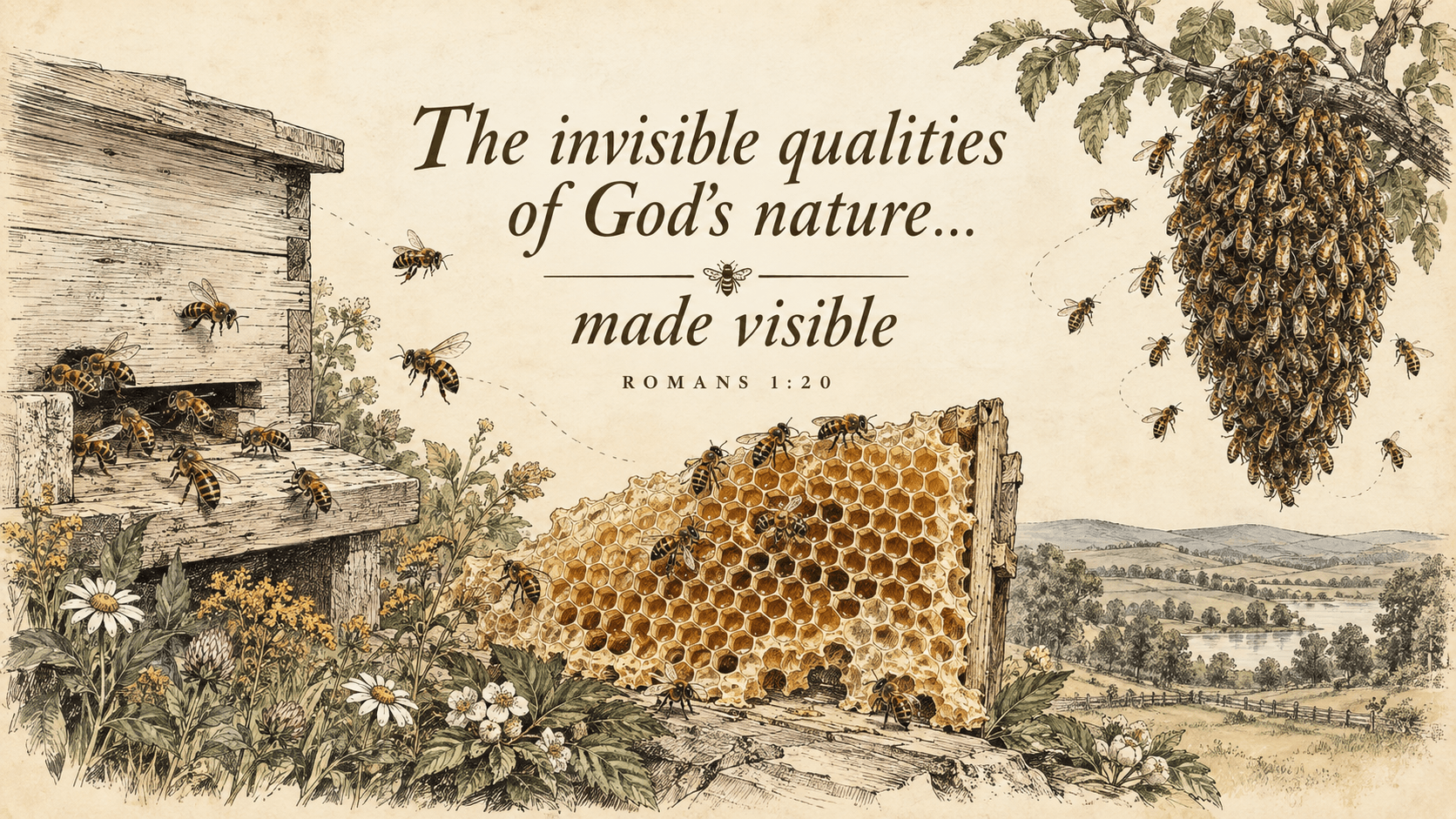
Anchor: Romans 1:20
Also touches
Civil War Recordcivil war
The 1st Minnesota's charge at Gettysburg, July 2, 1863
- On July 2, 1863, the second day at Gettysburg, the Union Third Corps under Daniel Sickles was broken and retreating through a gap in the Union line, and a fresh Alabama brigade the manuscript gives as fifteen hundred men came across the swale (a low dip in the ground in front of the ridge); General Winfield Scott Hancock, who commanded that part of the line, with maybe five minutes to plug the gap, ordered the 262 men of the 1st Minnesota to charge a brigade six times their size, buying the line a handful of minutes to reform (the fifteen-hundred figure is the manuscript's; not itemized in the notes files)
- 215 of the 262 men fell (killed, wounded, or missing) — 82 percent, the highest casualty rate any surviving American military unit has taken in a single engagement, before or since; Hancock said of the charge, "no more gallant deed recorded in history" (confirmed 2026-09-09 as a real, widely documented quote)
- Philip Hamlin (the final manuscript calls him a young sergeant; the one notes source that names his rank, Windhauser's Minnesota History article quoted in notes/research/first-minnesota-sources-slot-hunt.md, calls him a corporal) survived the charge only to die the next day in the repulse of Pickett's Charge. His last letter home, dated June 25, 1863, closes: "I know that whatever befalls me, all is well for I am in safe hands. Oh, it is sweet to trust in the All Seeing One..." — sourced to killedatgettysburg.org's dedicated Hamlin biography, which draws on his actual wartime letters; his comrade Sergeant James Wright's tribute ("an honest, earnest, consistent, Christian man," his faith "open, unostentatious, frank, manly") is correctly named and quoted, correcting an earlier draft's vague, unattributed paraphrase (the added "open, unostentatious, frank, manly" words are in the current manuscript and are not itemized in the notes files)
- In early June 1865, in Richmond, on Communion Sunday at St. Paul's Episcopal Church, a tall, well-dressed Black man walked to the communion rail while the white congregation stayed seated; Robert E. Lee then rose, walked to the rail, and took communion next to him (the final manuscript's wording), and other people followed. The manuscript adds that St. Paul's is the church where Jefferson Davis had been sitting two months earlier when a messenger brought word that Richmond was about to fall, and that in a white Southern church of the time Black worshipers were expected to wait until every white person had gone up for communion (neither point is cited in the manuscript or the endnotes). Thomas Broun, a Confederate veteran, was in the room and told the story forty years later; historian Philip Schwarz studied both of Broun's accounts and says nobody can know what Lee was thinking, and notes Broun's words can be read as Lee showing his own dignity more than welcoming anyone. The man's name is not known (Broun, "Negro Communed at St. Paul's Church," Richmond Times-Dispatch, April 16, 1905, p. 5; Confederate Veteran 13, no. 8, August 1905, p. 360; Schwarz, "General Lee and Visibility," 2000, rev. 2006, all as cited in the manuscript; no notes file covers this passage; the endnote in book/endnotes/part-4.md says it was read through Schwarz only and both 1905 originals should be pulled before print)
- Lee's own words and acts, as the manuscript tells them: in a December 1856 letter to his wife he called slavery as an institution "a moral & political evil in any Country" (the manuscript adds that the same letter calls it a greater evil to white people than to Black people, and that the rest of it does not read well today); in December 1862 he signed the papers freeing the people his father-in-law's will had left in his charge; in February 1865 he wrote a Confederate congressman that enslaved men should be allowed to fight and that those who did should be freed. The manuscript pairs these with the communion scene and says that, whatever Lee fought for, that Sunday his feet went toward a more Christian future than the one he had defended (Robert E. Lee to Mary Anna Randolph Custis Lee, December 27, 1856, Lee Family Papers, Virginia Museum of History & Culture; deed of manumission for the Custis estate, December 29, 1862, Richmond Hustings Court; Lee to Ethelbert Barksdale, February 18, 1865, all as listed in book/endnotes/part-4.md; no notes/research file covers them)
- Gettysburg also left the story of Charlie Coulson, as told by the surgeon Max Rossvally, who was born Mordecai Rosenthal in Germany and raised in the Jewish faith. After the battle, in a field hospital, Rossvally treated a seventeen-year-old drummer named Charlie Coulson, whose arm and leg had to come off; Coulson refused chloroform and brandy because he wanted a clear mind to meet his Savior, lived a few more days, and before he died told the doctor he had been praying for him and asked him to trust Jesus too. The manuscript says that about ten years later, in New York, a barber's talk of Jesus coming for the lost sheep of Israel and then a revival meeting in Washington led Rossvally to become a Christian; he spent the rest of his life telling his own people about Jesus, in New York and later in Leeds, England, where he died in 1892. The manuscript notes we have the story because Rossvally wrote it down himself in a tract (M. L. Rossvally, Charlie Coulson, the Drummer Boy, n.d.; birth name and Leeds life per "Leeds Veterans of the American Civil War (Part 2)," The Secret Library, Leeds Libraries Heritage Blog, July 2, 2024, both as listed in book/endnotes/part-4.md; no notes/research file covers this passage and it is not in the endnote audit)
- A follow-up research pass cross-checked the casualty figures against an independent source (a documentary fundraising proposal citing ~220 rather than 215 losses) and judged the discrepancy likely imprecision in a rough, uncited document, not a correction; the manuscript's already-confirmed 215-casualty, 82-percent figure stands
Primary sources (5)
- killedatgettysburg.org, Philip Hamlin biography
- Thomas Broun, "Negro Communed at St. Paul's Church," Richmond Times-Dispatch, April 16, 1905, p. 5; Confederate Veteran 13, no. 8 (August 1905), p. 360; Philip Schwarz, "General Lee and Visibility" (2000, rev. 2006) (all as cited in the manuscript)
- notes/research/first-minnesota-sources-slot-hunt.md
- The final manuscript carries no inline page citations; the citations behind this chapter (including Rossvally and the Lee letters) are collected in the book repo's book/endnotes/part-4.md, and book/endnotes/audit-part-4.md lists what is still open
- research/bee-facts-and-meade-council-2026-09-13.md
partly verified
From the Book
Bees teach you more than you'd expect. It's all in there, humming away in a stack of wooden boxes. One evening I stood by my hive with the smoker gone cold, just watching. The last foragers came in heavy with pollen, wings frayed from all the miles they'd flown. Guards held the entrance and house bees capped cells. Every bee moved like it knew exactly where it belonged, and it felt like a hymn. As a kid, I pedaled past the beekeeper’s white boxes with my eyes shut. After all these seasons of stings and honey, I finally get something I didn't then. The hive is a mirror. Once you've seen God's design, His sacrifice, and His beauty in it, you can't unsee it.
Get the full book →