© 2026 Casey Spitnale
Chapter 28
Cleverly Devised Stories
What the Witnesses Saw
“Such appears to be the truth about the generation of bees, judging from theory and from what are believed to be the facts about them; the facts, however, have not yet been sufficiently grasped; if ever they are, then credit must be given rather to observation than to theories, and to theories only if what they affirm agrees with the observed facts.”
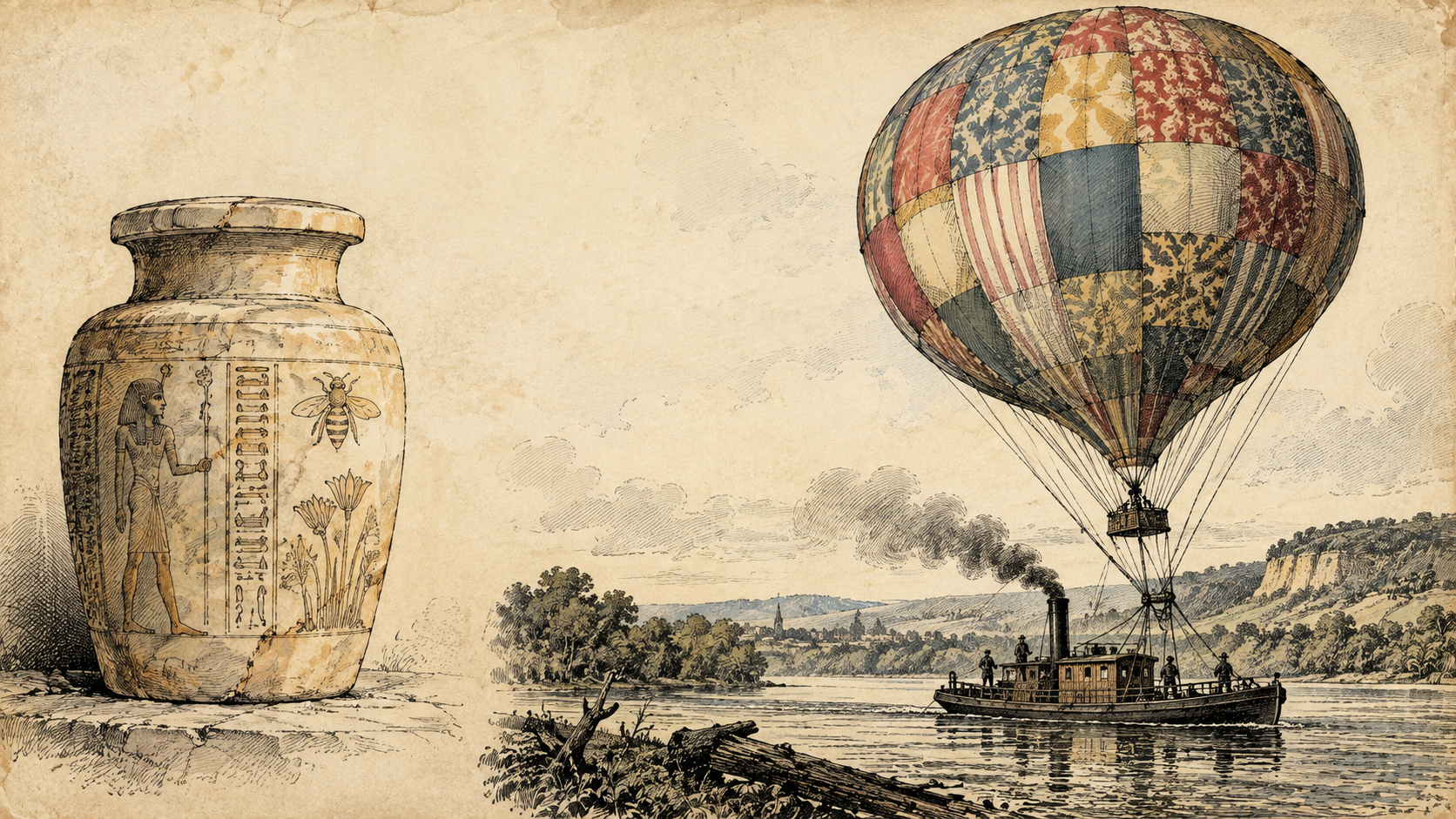
Some of the best-known bee stories got better the further they traveled. The "Einstein said bees are four years from the end of us" line traces back to Maeterlinck in 1901, who called his figure an estimate. Over decades the hedges dropped off and a famous name got attached. Einstein did write about bees, though, and his real letter is a careful one that turns on the word "unless." The bumblebee that "can't fly" and the honey "that never spoils" get the same treatment. The French zoologist behind the flight line filmed flying insects and said the math was what fell short. It took about sixty years to find what the math was missing. The tomb jar of edible honey turns out to be a chain of reports where "like honey or syrup" hardened into "honey." Sealed honey does keep a long time, and water content decides when it stops. The Civil War strand is a chain of printings too. A Confederate balloon was made of silk in many patterns, and by 1886 it was every silk dress in the Confederacy. Sherman's 1880 words in Columbus lost their second half over a few years of reprinting. Luke and Peter draw the line the chapter is after: an orderly account carefully investigated, and "we were eyewitnesses." Casey takes that as a charge for the book, keeping the "I was there" and "I read it" parts clearly apart.
Bee Science
- The Maeterlinck line behind the Einstein quote is an estimate
- In 1901 Maeterlinck wrote that it is "actually estimated" that more than a hundred thousand varieties of plants would disappear if bees did not visit them; he named no one who did the estimating
- Most of the world's leading crops don't depend on animal pollination
- By volume, about 60 percent of global crop production came from crops that don't depend on animal pollination and about 35 percent from crops that do; the rest wasn't evaluated. Pollinators were essential for 13 crops. "Animal pollination" covers far more than honeybees
- Insect wings make two to three times the lift the old airplane-style math allows
- The old calculation treated an insect wing like a fixed airplane wing in steady air. Most insects get the extra lift from a small swirl of air along the front edge of the flapping wing; for bumblebees, steady-air math can't explain even fast forward flight
- The scientist behind the "bumblebee can't fly" line filmed insects flying
- By 1932 Antoine Magnan was filming insect flight at up to twelve thousand frames a second, and in 1933 he and Sainte-Laguë wrote about insects hovering at a flower, bumblebees among them, on what they called extraordinarily little power
- Honey ferments or holds depending on its water content
- Under 17.1 percent water, honey won't ferment in a year no matter how many yeasts it carries; above 19 percent water, it can be expected to ferment even with only one spore per gram; in between, it depends on the yeast
- Tomb honey didn't survive three thousand years as honey
- The liquid in the Yuya and Tjuyu vase was reported as castor oil, and Lucas found the Tutankhamun jars marked as honey practically empty, with negative sugar tests; the Egyptians did place honey in tombs, and sealed honey keeps a long time
Cited research (5)
- Klein et al. (2007), Proceedings of the Royal Society B 274:303-313: Share of world crop production, by volume, that does and doesn't depend on animal pollination
- Ellington (1999), Journal of Experimental Biology 202:3439-3448: Leading-edge vortex explains the extra lift in insect flight that steady-air airplane math missed
- Dudley & Ellington (1990), Journal of Experimental Biology 148:53-88: For bumblebees, quasi-steady aerodynamic mechanisms are inadequate to explain even fast forward flight
- Dyer et al. (2021), Journal of Comparative Physiology A 207:449-456: Einstein's 1949 letter to Glyn Davys, in which he wonders whether bees might have "a new kind of sensory perception"
- USDA, Beekeeping in the United States, Agriculture Handbook No. 335 (rev. 1980), p. 89: Water-content thresholds for honey fermentation
Scripture
Anchor: Romans 1:20
Also touches
Civil War Recordcivil war
The Silk-Dress Balloon (1862) and Sherman's "War Is Hell" (1880)
- In the summer of 1862 Confederates around Richmond sent up their own balloon. E. Porter Alexander, the signal officer, wrote that it was "made from silk of many patterns." The gunboat carrying it, the Teaser, ran aground on July 4 and the Union gunboat Maratanza took "both boat and balloon, the crew escaping"
- The Union lieutenant's report says only that they captured "a Confederate balloon, a quantity of submarine telegraphic wire, and other appliances for submarine batteries"; it says nothing about dresses. The manuscript glosses submarine batteries as underwater mines
- Eight days after the capture, Sanitary Commission volunteer Georgeanna Woolsey wrote in her journal that it was made of the old silk dresses of the ladies of Richmond; Harper's Weekly printed "made of old silk frocks" on August 2, 1862; and in 1886 General James Longstreet turned it into a legend about gathering every silk dress in the Confederacy
- The Smithsonian's National Air and Space Museum, which holds a piece of the balloon, says the dress silk was bought by the length in Savannah and Charleston, not donated dresses. The balloon ended up with Thaddeus Lowe, who cut it up for souvenirs
- At a soldiers' reunion in Columbus, Ohio, on August 11, 1880, a telegraph news report, as a Sacramento paper printed it the next day, has Sherman saying "it is all hell. I look on war with horror; but if it has got to come I am here." Later printings added and dropped words, and none of the printings the chapter cites has the three-word "War is hell"
Primary sources (8)
- E. Porter Alexander, Military Memoirs of a Confederate (Scribner's, 1907), pp. 172-173
- Official Records of the Union and Confederate Navies, Series I, Vol. 7 (GPO, 1898), p. 543
- Georgeanna Woolsey, journal for July 12, 1862, in Letters of a Family During the War for the Union (1899), vol. 2, p. 459
- Harper's Weekly, August 2, 1862
- James Longstreet, "Our March Against Pope," Century Magazine, February 1886, pp. 601-602
- National Air and Space Museum, "The Most Fashionable Balloon of the Civil War"
- The final manuscript carries no inline page citations; the citations behind this chapter are collected in the book repo's book/endnotes/part-4.md
- Sacramento Daily Record-Union, August 12, 1880; Sunday School Times, October 23, 1880; American Advocate of Peace and Arbitration, November-December 1885
verified
From the Book
I heard it back when it was going around everywhere, way before I ever had bees. Albert Einstein, supposedly, said that if the bees disappeared, people would have only four years left to live. And I thought it could be true. A famous name makes a line easier to believe. I believed this one could be true before I knew where it came from. I've tried to be more careful in this book. The biology needs to hold up before I build a comparison on it. That includes the beeswax-lined canteens in the wax chapter. I couldn't find evidence for that lining. Some of the best-known bee stories have the same problem. Following them back shows how a careful statement can turn into something its first speaker never said. Garson O'Toole, who runs a website called Quote Investigator that traces famous lines back to whoever really said them, went looking for where the Einstein line came from. The trail starts with Maurice Maeterlinck, the Belgian playwright, in 1901. In The Life of the Bee, he says we probably owe bees most of our flowers and fruits. He explains: "for it is actually estimated that more than a hundred thousand varieties of plants would disappear if the bees did not visit them." He never says who did the estimating, but he does say it's an estimate.
Get the full book →