© 2026 Casey Spitnale
Chapter 27
Telling the Bees
Grieving with Hope
“Trembling, I listened: the summer sun / Had the chill of snow; / For I knew she was telling the bees of one / Gone on the journey we all must go!”
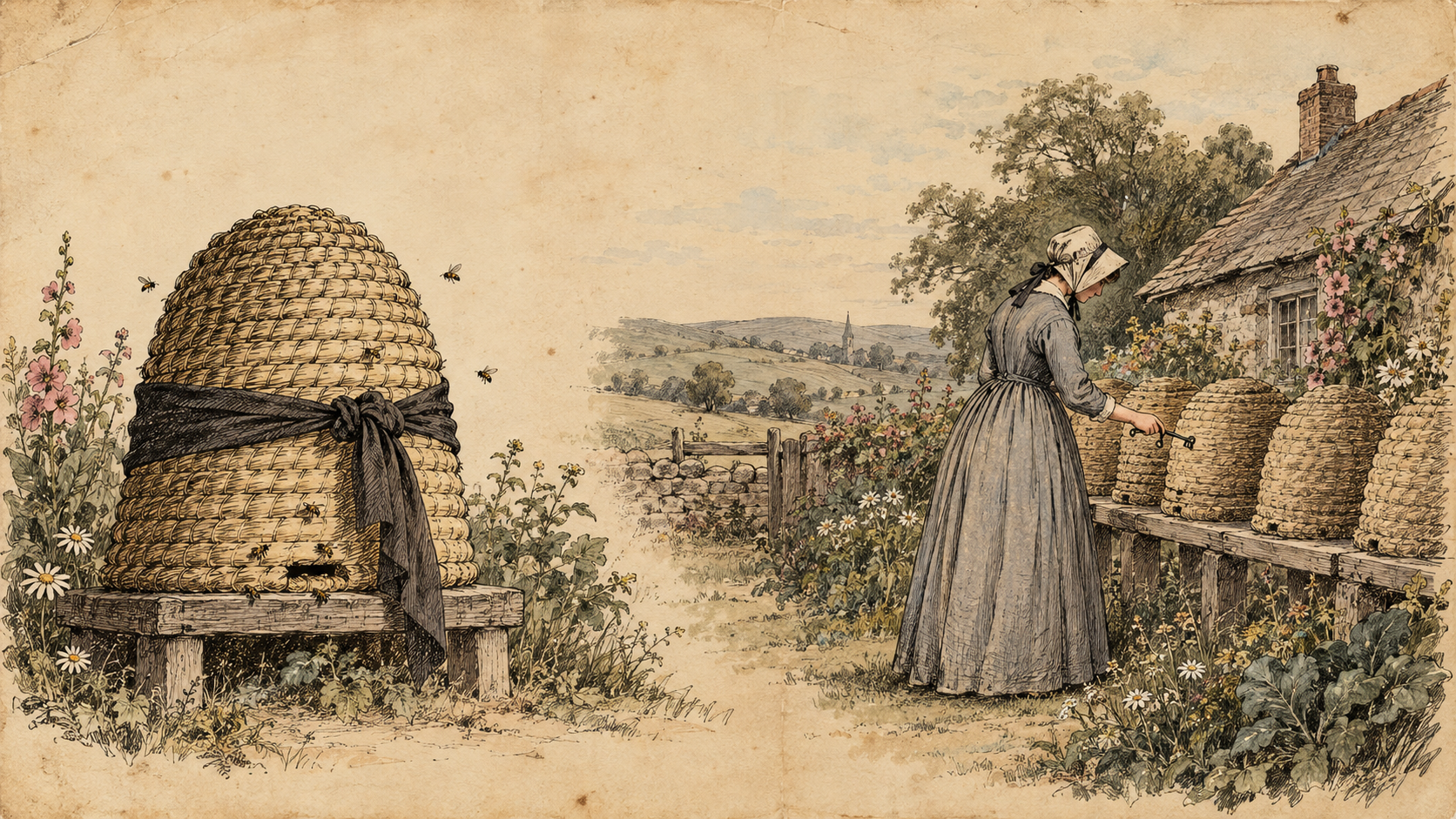
For a few hundred years, people in English farmhouses and cottages, and in a good many American homes, walked out to the hives and told the bees the news. Deaths came first, and the household went through small, specific steps: three taps with the house key, black crape on the hive, sometimes a dish of funeral food set out for the bees. Casey's chapter collects those customs from the folklorists who wrote them down, and it is plain about what they are. The colony has no way of knowing who is alive up at the house. What the custom shows is who a family counted as its own, and that nobody in the house was allowed to act as though the loss hadn't happened. The historical thread is John Greenleaf Whittier's 1858 poem "Telling the Bees," which ran in the Atlantic Monthly and, within weeks, in newspapers in Winchester, Virginia, and Salem, Ohio. The chapter reports honestly that its search found no wartime account of a family telling the bees about a soldier, and leaves that open. Paul's line to the church in Thessalonica anchors the ending: grief and hope can sit in the same room. The chapter closes with a small, unhurried idea, that the person who says a loss out loud, and listens the next time it needs saying, is doing what the old custom was for.
Bee Science
- The colony has no way to learn the keeper is gone
- the chapter's own point: a bee hears only air moving within inches of her antennae (chapter 19), and a colony notices a missing queen because it runs on her scent, but nothing signals that the keeper has died. The custom is about the household, not about bee biology
- A hard winter can explain a dead hive
- in 1867 near Wellington, Shropshire, a man refused a widow's request to tell her bees; months later the hives were dead although honey remained in the cells, and he noted the winter had been very severe and the hives unprotected
Scripture
Anchor: Romans 1:20
Also touches
Civil War Recordcivil war
Whittier's "Telling the Bees" (1858) in Winchester and Salem, and a 1863 newspaper filler on the custom
- The custom (folklore strand, not Civil War): in English and some American households the bees were told of a death, the hives were draped in black crape, tapped three times with a house key, or turned or lifted as the body left; J. G. Wood described it in Notes and Queries, Oct. 25, 1851, p. 309, and Charlotte Burne collected Shropshire cases in Shropshire Folk-Lore (1885), pp. 235-236
- Birth reports are thin: the only birth case in the chapter is a secondhand Sussex account in Ransome, The Sacred Bee in Ancient Times and Folklore (1937), p. 20 (research note status: partly verified)
- John Greenleaf Whittier, a Quaker, was a secretary at the December 1833 Philadelphia convention that founded the American Anti-Slavery Society and sat on the committee that drafted its Declaration of Sentiments (Pickard, Life and Letters of John Greenleaf Whittier, 1894, vol. 1, pp. 134-136)
- Whittier's mother died in late December 1857; on February 16, 1858 he sent James Russell Lowell the poem (as "The Bees of Fernside"), and the Atlantic Monthly printed it in April 1858 as "Telling the Bees" (Pickard, 1894, vol. 2, pp. 412-414). Pickard does not tie the poem to his mother, and the chapter says only that those are the dates
- The poem's setting is the Whittier farm in East Haverhill, Massachusetts; Pickard calls its story "wholly imaginative" (vol. 2, pp. 414-415). Whittier's own footnote says the custom "formerly prevailed in the rural districts of New England" (Atlantic Monthly, April 1858, p. 722)
- The poem was reprinted within weeks on both sides of the coming war: Winchester Republican (Winchester, Va.), April 23, 1858, p. 1, and the Anti-Slavery Bugle (Salem, Ohio), May 8, 1858, p. 4, where it was bylined "J. C. Whittier" (the paper's misprint)
- The North Branch Democrat (Tunkhannock, Pa.), June 3, 1863, p. 4, ran a filler headed "Superstition" describing the English custom, including telling the bees "of every important occurrence which may affect the country" (the print of "affect" is damaged; page-image reading per notes/research/before-print-checks-2026-09-24.md)
- Whittier's later war-era poems: "Barbara Frietchie" (Atlantic, October 1863; he wrote of the Frederick story, "As for the rest I do not feel responsible") and "Laus Deo!" (1865) (Pickard, 1894, vol. 2, pp. 454-457, 488)
- A newspaper search behind the chapter (Chronicling America, Internet Archive full text) found no documented case of a family telling the bees about a soldier's death, only the Whittier poem, reprinted English stories, fillers, and false matches. This does not show the practice never happened
Primary sources (8)
- Notes and Queries, Oct. 25, 1851, p. 309 (J. G. Wood; Alfred Gatty)
- Charlotte S. Burne, Shropshire Folk-Lore (1885), pp. 233-236
- Gutch & Peacock, Examples of Printed Folk-Lore Concerning Lincolnshire (1908), pp. 29, 241
- The Atlantic Monthly, April 1858, pp. 722-723
- Samuel T. Pickard, Life and Letters of John Greenleaf Whittier (1894), vols. 1 and 2
- Winchester Republican, April 23, 1858, p. 1; Anti-Slavery Bugle, May 8, 1858, p. 4; North Branch Democrat, June 3, 1863, p. 4 (loc.gov / Chronicling America)
- notes/research/extraordinary-hive-customs-folklore.md and extraordinary-hive-customs-folklore-part2.md
- The final manuscript carries no inline page citations; the citations behind this chapter are collected in the book repo's book/endnotes/part-4.md
partly verified
From the Book
I don't pull the family into telling the bees very often. Usually I'm the one out there talking to them. On the big things, I find it rewarding. I don't know if that's the right word for it, but it's relaxing, and it's emotional, to tell them what's going on. My dad was in the hospital, and I was frustrated with what was going on with my parents. I distinctly remember telling the bees about it in the middle of an inspection. I've also been out there when a family member was in the hospital. I've told them things about my kids, too, sometimes their awards or achievements. Saying it out loud, between the bees and God, fills me with a kind of amazement. It's inspiring, and it makes me reflect on the truth of my life, the struggles and the stress of it. And the whole time there's the bees' constant hum, the assurance that life will still go on. For a few hundred years, nobody in farmhouses and cottages all over England would have asked whether the bees should hear news like that. The same was true in a good many American homes. Somebody from the house walked out and told them. Everywhere else in this book the bees carry the news and we stand outside trying to read it. This is the one place where people did the telling, and they took it seriously enough to stop a funeral over it.
Get the full book →