© 2026 Casey Spitnale
Chapter 26
What Her Sisters Carry
Belonging to the Body
“Isolate her, and however abundant the food or favourable the temperature, she will expire in a few days not of hunger or cold, but of loneliness. From the crowd, from the city, she derives an invisible aliment that is as necessary to her as honey.”
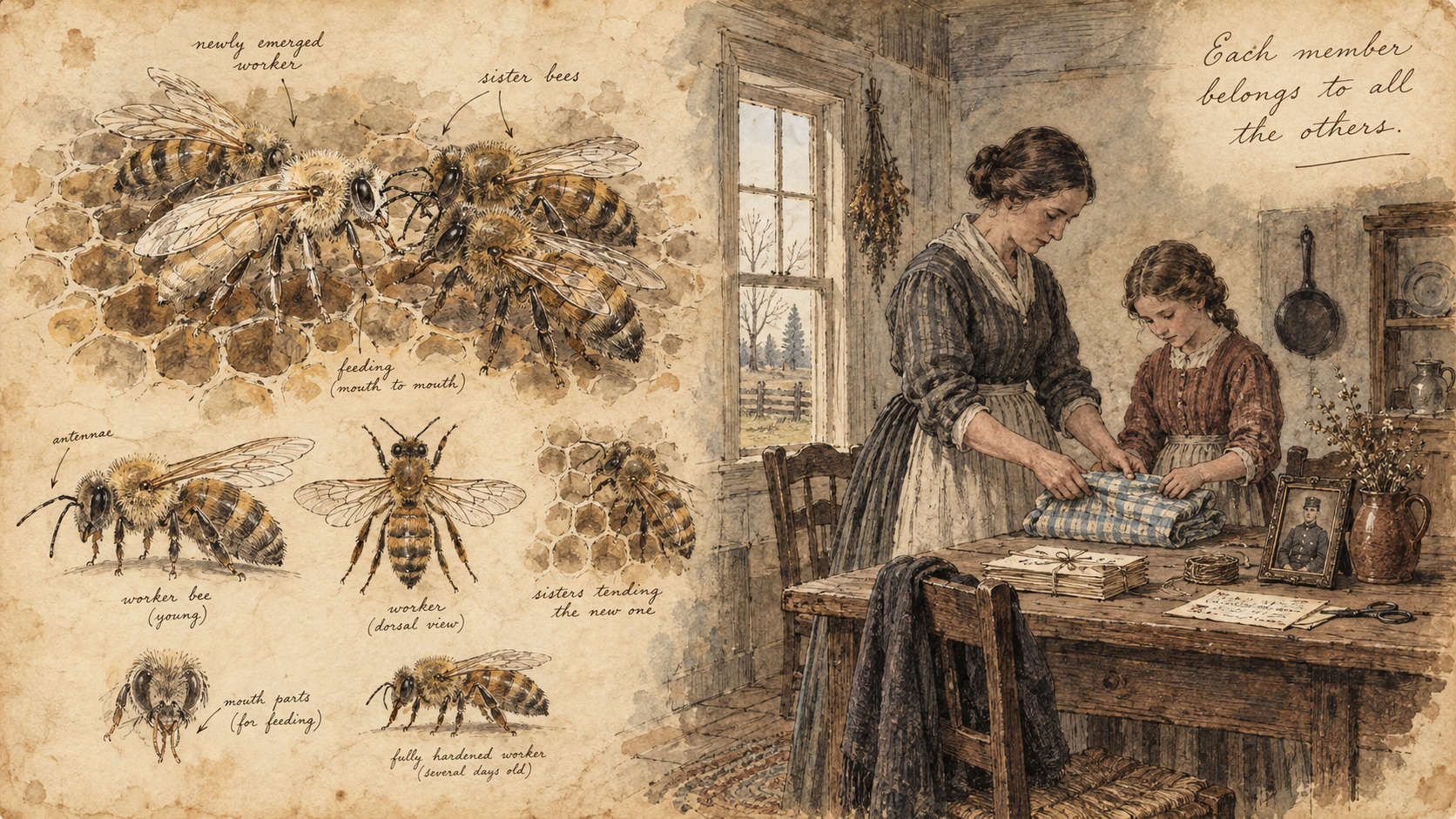
A new worker bee comes out of her cell with an empty gut, and the bacteria she needs to fill it don't live anywhere in the world outside a bee. She can only get them from her older sisters, up close, some of it from what they leave behind for her. Nancy Moran's lab traced exactly how that handoff happens, and a 2026 University of Lausanne study went further: no single member of that five-species community, and no community missing even one member, gave a bee the same learning and memory boost as the whole community together. The benefit belongs to the group, not to any one member of it. Camp measles taught Civil War armies a version of the same lesson in 1861. Rural recruits who'd never been exposed as children got sick far more often than city recruits who'd already had it. Thomas Smiley, a nineteen-year-old private in the future Stonewall Brigade, caught it that June, and his family's letters survive: an aunt's prayer-meeting news, his mother sending an oilcloth to keep him dry, and his sister Mary's rebuke for hiding how sick he'd really been -- "truth is always better than uncertainty." Casey reads both stories through Romans 12:5 and 12:15: each member belongs to all the others, and a body rejoices and mourns together. What keeps a person steady rarely comes from one good friend or one good service. Like a bee's gut community, it only works as a whole body, passed hand to hand.
Bee Science
- A new worker bee's gut starts essentially empty
- she sheds her gut lining during metamorphosis and emerges with few or no gut bacteria; within four to six days in the hive her hindgut holds the same large, settled bacterial community older workers carry, roughly 100 million to 1 billion cells. About nine kinds of bacteria make up nearly all of it, and five of those turn up in almost every adult worker checked; these are not the honey-stomach bacteria from the pollen chapter
- The core gut community exists nowhere but inside bees
- the five core bacterial species can't multiply at ordinary atmospheric oxygen levels and have never been consistently found outside the bee gut, so a new bee can only acquire them from other bees, not from flowers or the environment. The same community turns up in bumblebees and other close relatives that live in colonies, and so far has not been found in solitary bees
- Comb and stores alone can't pass on the real community
- in 2014 Nancy Moran's lab put newly emerged workers in small cages with different possible sources: pieces of the hive (comb, honey, bee bread), only mouth-to-mouth feeding from other bees, older nurse bees, or the nurses' droppings. Young bees given only comb and stores grew the wrong community, and so did those given only the feeding, with core bacteria missing or the mix badly out of balance; the bees kept with nurses, or given what the nurses left behind, grew the normal core community
- Two of the core members live in layers and share a diet
- Snodgrassella sits against the gut wall with Gilliamella on top; Snodgrassella cannot use sugar at all and runs on acids, some of them the very ones the sugar-eating members leave behind. Snodgrassella is named for R. E. Snodgrass, the anatomist the body chapter leans on, and Gilliamella for Martha Gilliam, for her early work on the microbes of the hive
- The gut community drives measurable weight and gene-activity gains
- Moran's group at the University of Texas raised new bees on the same sterilized food, some dosed with the hindgut contents of older nurse bees and some not; the bees given their gut community gained 82 percent more weight over the first two weeks, and their vitellogenin gene (the blood protein the house-bee chapter's winter bees are loaded with) was nearly five times as active
- No single gut species accounts for the cognitive benefit
- in May 2026 Amélie Cabirol and her colleagues in Philipp Engel's lab at the University of Lausanne, in Switzerland, used pupae from sixteen campus colonies over three seasons. Pupae came out as adults in sterilized boxes, so every bee started empty, and each new bee got a drop of sugar water with either a community the lab built from eleven strains of the five core groups, just one of the five, the whole community with one group left out, or nothing. About a week later each bee was tested on a sugar-and-scent reflex: two scents over and over, one always paired with a touch of sugar water and one with nothing. Every group learned something, the empty bees included, but bees carrying the whole community learned it better: by the last round about 20 percent more of them responded to the rewarded scent than bees raised with nothing, and they remembered it better a quarter hour later. No single member did measurably better than nothing, and neither did any group missing a member (leaving out Gilliamella or Snodgrassella cost the most). It was not appetite: every group responded to sugar itself about the same. About twenty gut compounds tracked with learning, many of them from breaking down the amino acids tryptophan and lysine, two of the building blocks of protein; several members made the same compounds, so removing one left much of that chemistry in place and the learning edge still disappeared. The authors' word is emergent, a benefit that belongs to "the community as a whole." The chapter notes that a Beijing lab got one kind of Lactobacillus to sharpen memory only after extra tryptophan was added to the bees' food, and that eleven strains are not the whole community of a real hive
Cited research (5)
- Kwong & Moran (2016), Nature Reviews Microbiology 14(6):374-384: Review establishing the five core gut species, their confinement to social-bee guts, and the newly emerged worker's empty gut
- Powell, Martinson, Urban-Mead & Moran (2014), Applied and Environmental Microbiology 80(23):7378-7387: Cup-cage experiment showing a normal gut community requires exposure to nurse bees or nurse hindgut material, not hive comb/stores alone
- Zheng, Powell, Steele, Dietrich & Moran (2017), PNAS 114(18):4775-4780: Germ-free vs. colonized bees: 82% more weight gain and nearly five-fold higher vitellogenin gene activity in colonized bees
- Zhang, Mu, Cao, Shi, Hu & Zheng (2022), Nature Communications 13:2037: One Lactobacillus species alone improved memory only when paired with extra dietary tryptophan
- Cabirol et al. (2026), PNAS 123(21):e2608600123: Anchor study: a defined five-genus community, not any single genus or a community missing one genus, produced the learning/memory benefit -- an emergent, whole-community effect
Scripture
Anchor: Romans 1:20
Also touches
Civil War Recordcivil war
Camp Measles and the Smiley Family Letters, 1861
- Union medical records show 67,763 measles cases among white troops with 4,246 deaths (6.27% fatality), plus 8,555 cases and 931 deaths among U.S. Colored Troops (the Union army's Black regiments); the Confederate army gathered at Manassas logged 8,617 cases in three months of 1861, one man in every seven
- Most of the measles deaths came from the lung trouble that followed; the first year was the worst, with whole new regiments forming at once, and the counts miss men who suffered at recruiting camps before their regiments were mustered in. The Confederate army gathered around Manassas logged its 8,617 cases in July, August and September of 1861 alone (Smart, 1888, pp. 649-650)
- Army surgeons found rural recruits far more vulnerable than city recruits ("Recruits from the city are more likely to have passed through the disease in childhood than those from the rural districts"); Surgeon C. J. Walton of the 21st Kentucky reported on March 31, 1862 that the Green River-country men in his regiment, "with few exceptions, had not had measles" (Smart, 1888, p. 652), and Professor Paul Eve, a Georgia surgeon, reported that on the Confederate side measles spread through new regiments "especially in those from the country" (quoted in Smart, 1888, p. 649)
- Thomas Martin Smiley, 19, of Augusta County, Virginia, enlisted in the 5th Virginia Infantry (the future Stonewall Brigade) in April 1861 (Company D); his family's letters -- his aunt Ellen Martin (June 4, 1861, his nineteenth birthday), his mother Christiana (an oilcloth table cover to keep the damp off and wrap around him on guard), and his sister Mary -- survive describing their worry, and his silence about how sick he'd really been. Measles reached the camp by June; by mid-July his family knew, secondhand, that he was in the hospital
- His sister Mary's line after learning secondhand that he'd been hospitalized: "truth is always better than uncertainty"
- Thomas Smiley, six foot two and a farmhand on his father's farm, wrote his aunt from Harper's Ferry in May 1861 that he was "enjoying good health and in good spirits." He recovered, was back on picket near Centreville by October, was wounded in the hand and face at Chancellorsville, and was captured on May 12, 1864 when Hancock's men broke into the Mule Shoe salient (a bulge in the Confederate line shaped like a horseshoe) at the Battle of Spotsylvania Court House, then held at Fort Delaware; he survived the war, was farming in Augusta County by 1870, gathered his old company's names for a muster roll the Staunton paper printed in 1893, and died in November 1920, buried at New Providence (manuscript ch.26; the Chancellorsville wound, Fort Delaware, farming by 1870, the 1893 muster roll and the New Providence burial are all in notes/research/camp-measles-1861-smiley-letters.md, from his compiled service record and the 1870 census)
Primary sources (3)
- Charles Smart, The Medical and Surgical History of the War of the Rebellion (1861-65), Part III, Vol. I (Washington: GPO, 1888), pp. 649-661
- Smiley Family Papers, Albert and Shirley Small Special Collections Library, University of Virginia (Valley of the Shadow project transcriptions)
- Ethan S. Rafuse, "Stonewall Brigade," Encyclopedia Virginia
verified
From the Book
I noticed the new bee when she was already partway out of her cell. She looked determined. Once she was free, she went straight to work. From where I stood, she seemed to have everything she needed. I couldn't see what was still missing. A newly emerged worker has few or none of the gut bacteria she will carry as an adult. She has to get them from the colony around her. That isn't a flaw. While she was turning from a larva into an adult under that wax cap, she shed the lining of her gut. She comes out with few or no gut bacteria at all. Give her four to six days in the hive. Her hindgut, the back end of her gut, develops the same kind of large, settled community the older workers carry. That's somewhere between a hundred million and a billion bacterial cells. These aren't the honey-stomach bacteria from the pollen chapter. They live further back, past the stretch of gut that digests her food, and they're a small, particular crowd. About nine kinds make up nearly all of it, and five of those turn up in almost every adult worker anyone has checked.
Get the full book →