© 2026 Casey Spitnale
Chapter 23
Out of the Eater
Known by the Honey
“These, like the faithful animals from which they were produced, inhabit the green fields, delight in toil, and labor for reward.”
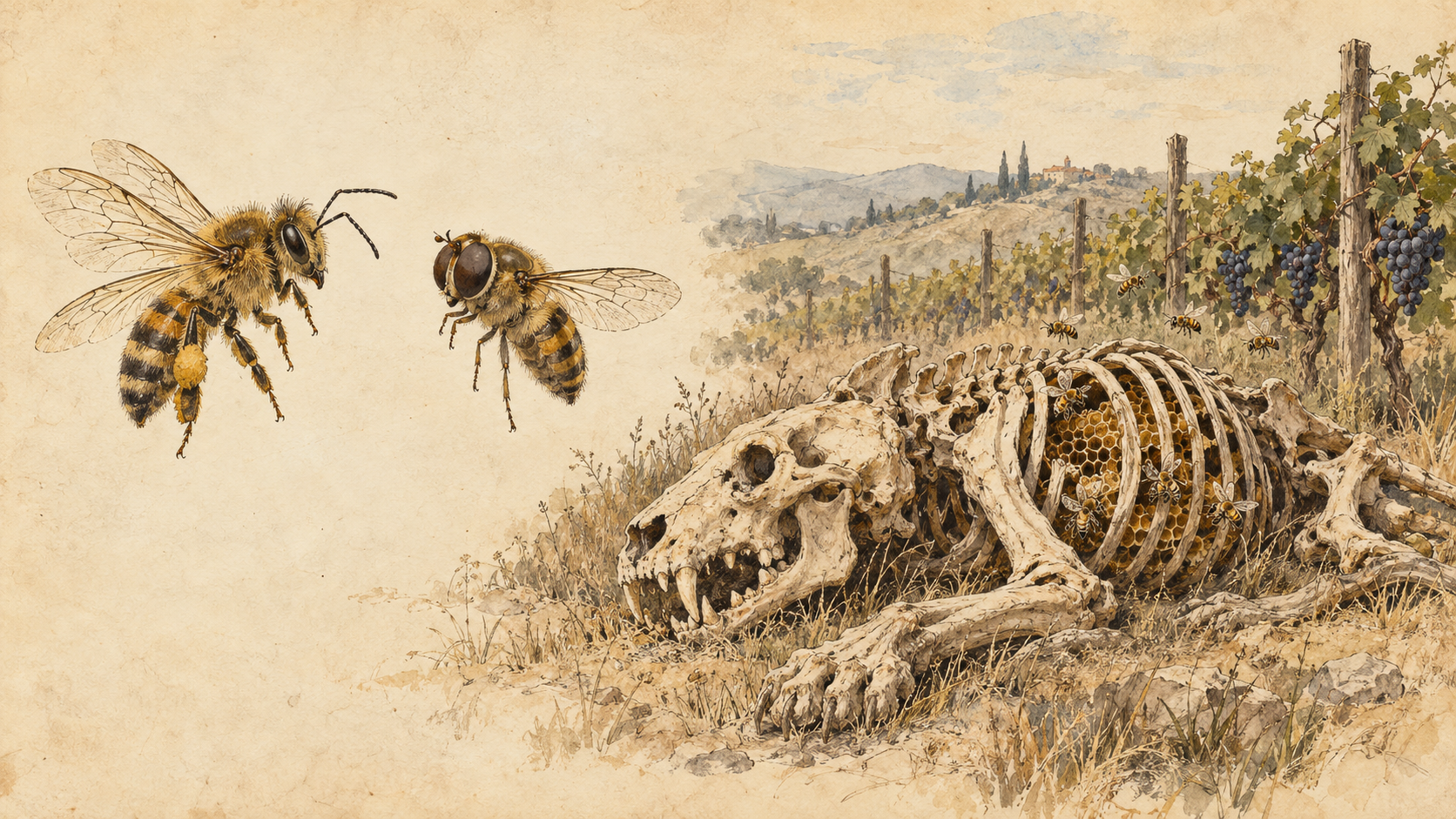
Chapter 23 starts with a fly. The drone fly (Eristalis tenax) wears a honeybee's shape, fuzz and color, and it even flies like one, but it has two wings, no sting, and has never made a drop of honey. For more than two thousand years, people believed honeybees could be born from the carcass of a dead ox, and Baron Osten Sacken's 1894 argument is that this fly is probably why. Then the chapter goes to a lion. In Judges 14, Samson finds a swarm and honey in a carcass and builds a riddle on it: "Out of the eater, something to eat; out of the strong, something sweet." The chapter weighs the commentators (a dried-out carcass is just another hollow for a swarm to grade), notes that the Hebrew word for the swarm is the same one used for Israel's congregation, and follows the ox-born bee belief through Virgil, Varro and Ovid. Osten Sacken's own story sits inside the Civil War. He was a Russian diplomat in Washington and New York, and the Smithsonian fire of January 1865 destroyed his manuscript. He wrote it again. The chapter is honest about the limits of his idea, and lands on his best observation: the old experimenters got something that looked like a bee, but nobody ever got honey out of it. That is the verse the chapter leans on. Matthew 7:16 says people are known by their fruit, and the look of the thing is the easy part. A closing scene from Sam Watkins at Perryville, two enemy pickets sharing a bucket of honey the night before a battle, asks what a life leaves behind. Inside a hive, nobody goes by the coat.
Bee Science
- The drone fly is a honeybee mimic
- Eristalis tenax has a honeybee's shape, fuzz and color, and researchers who compared the two found it flies more like a honeybee than like other flies. A bee has four wings; the drone fly has two and no sting
- The fly's larvae live in rotting, stagnant water
- Drone fly larvae (rat-tailed maggots) live in stagnant water rich in decaying organic matter. Osten Sacken argued a sealed shed would suit raising them, since it slows drying and keeps ordinary blowflies out
- Swarms look for hollows
- A dried-out carcass is a cavity, and a swarm is looking for one; Herodotus (Histories 5.114) records a swarm filling a hollow head with honeycomb
- Three stingless bees eat carrion and still make honey
- A stingless bee in the American tropics was reported in 1982 to use carrion instead of pollen as a protein source. It and two close relatives are the only bees known that can't do without meat, and all three make honey, described as "sweet, clear honey that contains some pollen" of unknown origin
Cited research (4)
- Golding, Ennos & Edmunds (2001), Journal of Experimental Biology 204: Compared drone fly and honeybee flight; the fly flies more like a honeybee than like other flies
- Osten Sacken (1894), On the Oxen-Born Bees of the Ancients (Bugonia), Heidelberg: The argument that the ancient ox-born bee belief traces to drone flies breeding in carcasses; he names the objections to his own idea
- Ludoški et al. (2023), Ecology and Evolution 13: Drone fly larval ecology in stagnant, organic-rich water
- Roubik (1982), Science 217; Camargo & Roubik (1991), Biological Journal of the Linnean Society 44; Figueroa et al. (2021), mBio 12: The carrion-feeding stingless bees, often called vulture bees, and their honey
Scripture
Anchor: Romans 1:20
Also touches
Civil War Recordcivil war
Ox-born bees from Virgil to a Russian baron in Civil War New York, and a bucket of honey at Perryville, 1862
- Virgil (Georgics IV), Varro (On Agriculture) and Ovid (Metamorphoses XV) all record the belief that bees could be produced from the carcass of a dead ox; Varro says the Greeks called bees "ox-sprung"
- C. R. Osten Sacken was secretary of the Russian legation in Washington from 1856 and Russia's consul general in New York from 1862 to 1871; he spent the war years on the flies of North America (Record of My Life-Work in Entomology, 1903, pp. 2-3, 73)
- The Smithsonian building burned on January 24, 1865; Joseph Henry wrote Osten Sacken on February 4 that his Limnobina memoir was destroyed, and Osten Sacken had kept no copy. He rewrote it, and the volume appeared in January 1869. The Herald headline he recalled is his own 1903 memory and was not checked against the paper
- He found his first Eristalis tenax in America on November 5, 1875, on a window in Cambridge, Massachusetts (Osten Sacken, 1894, pp. 32-33)
- Sam Watkins of the 1st Tennessee wrote that he stood picket in Perryville the night before the battle (October 7, 1862) and that he and a Union picket across the street "captured a bucket of honey, a pitcher of sweet milk, and three or four biscuit" from a citizen's pantry. He wrote it in 1882, twenty years later
Primary sources (4)
- C. R. Osten Sacken, On the Oxen-Born Bees of the Ancients (Bugonia) (Heidelberg, 1894)
- C. R. Osten Sacken, Record of My Life-Work in Entomology (1903)
- Sam R. Watkins, "Co. Aytch," Maury Grays, First Tennessee Regiment (1882), pp. 52-53
- George F. Moore, A Critical and Exegetical Commentary on Judges (1895)
draft, awaiting Casey's review. Ancient and Osten Sacken quotes checked against primary scans per notes/extraordinary-drafts/new-out-of-the-eater.md (SOURCES); Watkins per notes/research/extraordinary-bees-in-america.md
From the Book
My wife gets texts about bees all the time, and nine times out of ten they're yellow jackets. It's almost gotten to the point where my default response is, "Have them send me a photo." Or, "Did they send a photo?" Most people see bees and think danger. Mistakes like that happen so often it's incredible, because anything that flies is annoying, and anything flying around your head gets a reaction. Yellow jackets don't even try to look like bees. One fly does, and it's been pulling it off for longer than any of us have been alive: the drone fly, Eristalis tenax. It has a honeybee's shape and fuzz and color, and researchers who compared the two found it even flies more like a honeybee than like other flies. The giveaway is the wings. A bee has four. The drone fly has two, and no sting at all. If one ever got you, you're in good company. For "more than two thousand years," as the man who finally figured it out put it, people believed honeybees could be born out of the carcass of a dead ox, "in the minds of the masses, as well as in books," and that fly is probably why. But this story starts with a lion.
Get the full book →