© 2026 Casey Spitnale
Chapter 24
The Queen's Chemical Crown
Speaking Without Words
“As there is a peculiar smell in each hive of bees, which appears to be the bond of union in the community of it,—bees knowing each other by smell—the intelligent bee-master will keep his hives as far asunder as he conveniently can.”
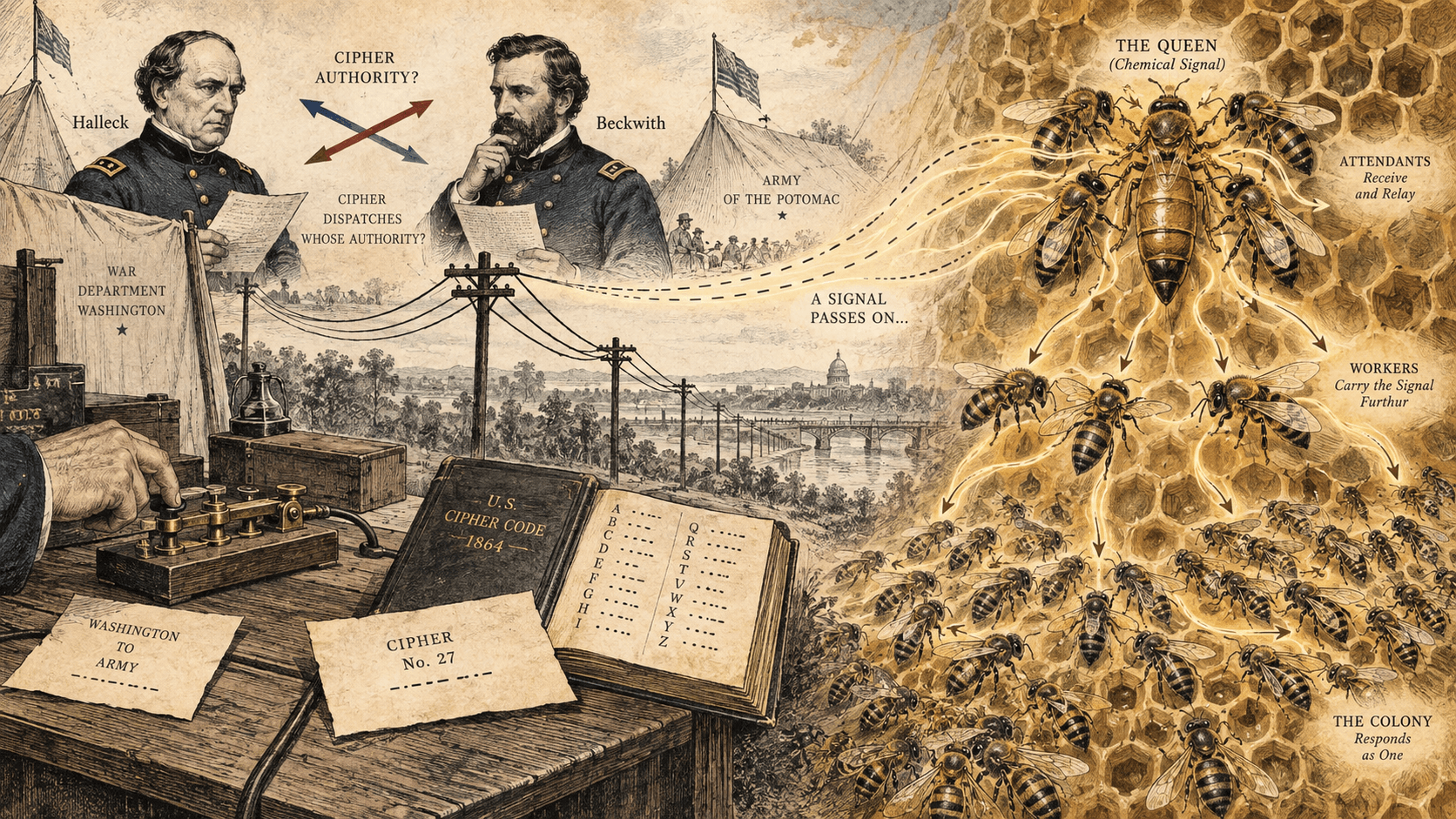
The chapter opens with the cost of getting authority wrong: Casey introduces a new queen to a hive only twelve hours into being queenless, and the workers ball her cage within seconds. They aren't confused about what she is. They just haven't recognized her yet, because her chemical signal, mostly the compounds that make up Queen Mandibular Pheromone, hasn't had time to spread through the colony and replace the scent of the queen they lost. That same question, who's actually authorized to hold the code, plays out in the Grant/Beckwith/Halleck cipher dispute the chapter tells alongside it. Beckwith wasn't wrong that the cipher mattered. He was caught in a real dispute over who had standing to know it, and it took Grant's own intervention to settle who counted as legitimate. Two later sections follow young workers whose brains, in lab studies, are shaped by the queen's scent (the chapter refuses to make a bee's brain say more than it does), and a soldier's letters home, where an inked finger and a traced hand stand in for a presence and John Richardson says he would rather see the finger than the mark. Thomas asking to see the nail marks sits beside that, with Jesus' blessing on those who believe without seeing. Casey's point isn't that chemistry and command work identically. It's that recognition takes time in both systems. A queen doesn't announce her authority once and get obeyed; her scent has to saturate the hive before fifty thousand workers stop treating her as a stranger. Paul's language in 2 Corinthians 2:14-15, the aroma of Christ spreading through those who encounter it, works the same way in the chapter's reading: presence recognized, not command issued, is what actually holds a body together. The chapter's closing argument, that scrambled communication (not any single villain) shows up across the science of Colony Collapse Disorder, extends that logic one step further: cut the signal off entirely, in a hive or a church, and the parts don't stop moving. They just stop moving with purpose.
Bee Science
- QMP is a blend, and its parts have different jobs
- queen mandibular pheromone is not one chemical: 9-ODA suppresses the development of worker ovaries and, on a mating flight, draws drones in from the Drone Congregation Area (at short range, tergal gland secretions help them home in); 9-HDA draws in her retinue, the attendants who feed and groom her; HOB and HVA round out the blend, and the five compounds together pull a retinue far more strongly than any one alone. (The manuscript no longer names the drone-antenna receptor AmOr11 here; that material sits in the drone chapter, ch.3, per notes/research/drone-eyes-and-queen-receptor.md.)
- Subspecies temperament is genetic, not just chemical
- the gentle Italian honey bee and the more defensive Africanized honey bee are the same species, Apis mellifera; how fast a colony comes boiling out of a box is mostly written in their genes
- Serotonin receptors concentrate in the royal-jelly gland
- the nurse's hypopharyngeal gland, which produces royal jelly, carries the bee's heaviest concentration of serotonin receptors; the team that mapped them in 2013 floated a 'tempting speculation,' offered explicitly as a guess, that serotonin signaling there may help decide which larvae become queens
- A queen's scent blocks young workers from learning to fear it
- bees can be trained to extend the stinger to a smell paired with an electric shock. Young workers living with the queen's scent could not learn that lesson, though they learned a smell paired with sugar just fine; it held in bees around six days old, not in bees fifteen days old. HVA, one part of QMP, 'bears a striking structural resemblance to dopamine'; young workers raised with the queen's scent carried less brain dopamine than bees raised without it, and HVA by itself blocks the lesson and switches on one particular dopamine receptor directly. The researchers' own guess is that it keeps young workers from forming an aversion to 'their mother's pheromone bouquet.' Young bees kept away from the scent early avoided it the way old foragers do, so the pull depends on the scent reaching them early. The alarm scent (which smells like bananas) disrupted learning in young bees raised without the queen's scent but not in those raised with it. These are lab measurements of learning and attraction, not of fear or love; the manuscript says it will not make a bee's brain say more than it does
- Queens mated to more drones drew bigger courts
- North Carolina State researchers gave queens the semen of either one drone or ten; the ten-drone queens drew bigger courts in the hive, and caged workers offered both queens' scents chose the ten-drone queen's
- Other signals in the hive
- Queen Retinue Pheromone combines QMP with compounds from other glands; footprint pheromones from her tarsal glands mark comb she has walked and help inhibit queen-cell construction there; Dufour's gland secretions are believed to mark her eggs as hers (researchers still debate the mechanism); tergal gland secretions help hold her retinue. Larvae give off brood ester pheromone, which carries information about the brood to tending workers and helps shift foragers toward pollen; the brood's signals also work with the queen's to suppress worker ovary development. In a crowded, growing colony her scent may reach each worker more weakly, part of the picture when workers begin queen cells ahead of a swarm. The alarm scent comes from defending workers' Koschevnikov glands near the sting apparatus, not from the queen
- Colony Collapse Disorder has no single settled cause
- the widest study of the disorder, as the final manuscript words it, measured sixty-one variables in ninety-one colonies from thirteen apiaries, and found 'no single factor was found with enough consistency to suggest one causal agent,' only that collapsing colonies carried more pathogens, and more kinds of them, than healthy ones. Neonicotinoids are a widely used family of insecticides. Sublethal doses can impair a bee's ability to find home and can blunt the sense of smell she uses to read the queen and brood; in 2012 a French team led by Mickaël Henry glued tiny radio tags onto foragers, gave some a low dose of a neonicotinoid and released them away from the hive, and the dosed bees were noticeably less likely to make it home. About a decade earlier, in an Italian imidacloprid study, barely half of bees at the lowest dose reported returned within two hours, and at higher doses they 'completely disappeared both from the hive and from the feeder within 24 hours.' The USDA's 2012 summary: 'No single silver bullet will solve the problems affecting honey bees.'
Cited research (9)
- Wanner et al. (2007), PNAS 104: 14383-14388: Identifies 9-ODA as the QMP component doing triple duty (retinue, ovary suppression, drone attraction) via the dedicated AmOr11 receptor; the same validated dataset used for ch.1's pheromone chart, cited here for this chapter's own 'Chemical Orchestra' table
- Breed, M.D., Guzmán-Novoa, E. & Hunt, G.J. (2004), Annual Review of Entomology 49: 271-298: Defensive-behavior genetics across Apis mellifera subspecies; source for the chapter's Italian-vs-Africanized comparison (same paper ch.7 cites for a different finding)
- Vergoz, V., Schreurs, H.A. & Mercer, A.R. (2007), "Queen pheromone blocks aversive learning in young worker bees," Science 317(5836): 384-386: young workers exposed to QMP cannot learn an odor-shock association, but learn odor-sugar normally
- Beggs, K.T. et al. (2007), PNAS 104(7): 2460-2464; Beggs, K.T. & Mercer, A.R. (2009), Current Biology 19(14): 1206-1209: HVA resembles dopamine; queen pheromone lowers brain dopamine in young workers; HVA activates the D2-like receptor AmDOP3
- Vergoz, V. et al. (2009), PNAS 106(49): 20930-20935; Urlacher, E., Tarr, I.S. & Mercer, A.R. (2014), PLoS ONE 9(12): e113630: early exposure to QMP determines whether young workers are drawn to it or avoid it; QMP protects young bees from the alarm scent's effect on learning
- Richard, F.-J., Tarpy, D.R. & Grozinger, C.M. (2007), "Effects of insemination quantity on honey bee queen physiology," PLoS ONE 2(10): e980: queens inseminated with ten drones' semen drew larger retinues and were preferred by caged workers over one-drone queens
- Thamm et al. (2013), PLOS ONE 8: e82407: Maps serotonin receptor concentration in the nurse's hypopharyngeal (royal jelly) gland; offers a hedged 'tempting speculation' that serotonin signaling may help determine queen caste
- Henry et al. (2012), Science: Sublethal neonicotinoid doses impair a forager's ability to find her way home; cited in the chapter's CCD/pesticide paragraph
- vanEngelsdorp et al. (2009): Widest CCD study to date (13 scientists, 61 variables, 91 apiaries): 'no single factor was found with enough consistency to suggest one causal agent'; cited in the chapter via Marra (2014)
Scripture
Anchor: Romans 1:20
Also touches
Civil War Recordcivil war
The January-February 1864 Grant/Beckwith/Halleck cipher-key dispute, and the Richardson letters of Ophelia's inked finger
- In January 1864, before leaving to inspect operations in Tennessee, Grant ordered his own cipher operator, Captain Samuel H. Beckwith, to hand the War Department's cipher key over to one of his staff officers so headquarters could keep decoding dispatches while he was away
- Beckwith refused at first, citing his standing orders straight from the War Department; Grant pushed back, "I told him if he did not he most certainly would be punished," and Beckwith handed over the key (Grant, Personal Memoirs, 1886, vol. 2, pp. 103-104, as cited in the manuscript)
- When Washington found out, General Henry Halleck was furious, declaring that Beckwith "should have gone to prison" over it, and, per the final manuscript, Secretary of War Edwin Stanton's War Department dismissed him
- Grant took the blame himself on February 4, 1864; Beckwith was reinstated February 14 and stayed at Grant's side decoding his dispatches for the rest of the war (he was later the first man in the country to telegraph word of John Wilkes Booth's whereabouts after Lincoln's assassination)
- Beckwith's rank, given in the manuscript as Captain, was independently cross-checked against Wikipedia, Find a Grave ("Capt Samuel Horace Beckwith"), and Grokipedia after one conflicting search result called him a Corporal; Captain, 11th New York Infantry, is correct
- On August 17, 1862, Rosetta Richardson wrote to her husband, John (Co. F, 48th Ohio), with an inked finger of their baby, Ophelia (about ten months old), at the head of the page and the words "Mother put the Babies finger in ink and put i on here so you could see it"; beside it, in a line the transcriber marks as John's, "i wood rather see the finger than the mark." He answered on August 26 on the blank half of the same sheet ("you last letter is the best yet") and sent her letter back "for a sampel" (Richardson letters, transcribed at 48ovvi.org; notes/research/northwest-ohio-local-history.md)
- In April 1863 John answered Rosetta's letter about her eyes: "if the worst cums to the worst and you loos your eye site you wil be the same to me as ever"; he promised to take care of her and told Ophelia, a year and a half old, to take good care of her mother if she went blind. That summer John's own eyes gave out at Vicksburg ("alive and well exsept mi eyes which ar very soar"). At the foot of John's February 8-10, 1864 letter someone at home traced a small hand in ink, labeled "Saturday March 5th 1864. O. A. Richardson's Hand mark"; nothing says it reached him (Richardson letters, April 8-11, July 25, August 13, 1863, and February 8-10, 1864). The Richardson letters are treated as public domain per Casey's 2026-09-24 decision
- Thomas's demand in John 20:25, 27, 29 ("Unless I see the nail marks in his hands...", "Put your finger here; see my hands", "blessed are those who have not seen and yet have believed") is paired with the Richardson marks; it replaced Isaiah 49:15-16 in the 2026-09-24 revision (notes/extraordinary-plan.md)
Primary sources (5)
- Emerging Civil War, "'He Should Have Gone to Prison': Grant, Stanton, and the Washington Cipher"
- Wikipedia, Samuel Beckwith
- Grant's own correspondence, Huntington Library
- Ulysses S. Grant, Personal Memoirs (1886), vol. 2, pp. 103-104 (as cited in the manuscript)
- J.E. Richardson letters (57, Co. F, 48th Ohio Volunteer Infantry), transcribed on 48ovvi.org: Letters of August 17 and 26, 1862; April 8-11, 1863; July 25 and August 13, 1863; February 8-10, 1864
verified
From the Book
The queen doesn't speak to her workers. Her chemical signals travel through the colony, and thousands of bees respond without hearing a word. I learned that the hard way when I tried to introduce a new queen. The colony had only been queenless for about twelve hours. The workers balled her immediately, forming a tight, suffocating knot around her cage within seconds. I was out twenty-five dollars and felt like an idiot standing there watching it happen. They could still smell their old queen. Her chemical signature lingers in a hive for days after she's gone, like a signal still playing after the station's gone off the air. I knew the new queen I was holding was a queen. The workers didn't smell one they recognized yet, so as far as they were concerned, she was an intruder. That afternoon's mistake had a biological explanation. The queen uses at least half a dozen pheromone systems. Each carries a different message, and none makes a sound. Once I started keeping several hives at once, I noticed each one had its own "personality." One colony stayed calm through every inspection. Another got defensive if I so much as breathed near the entrance. Same species, same yard, different queens, and with them a different set of genes and a different chemical signature running each house.
Get the full book →