© 2026 Casey Spitnale
Chapter 22
Milk and Honey
From Eden to the Font
“That comb is the spirit of life, and this the bees of the paradise of delight have made from the dew of the roses of life that are in the Paradise of God... whosoever shall eat of it shall not die for ever.”
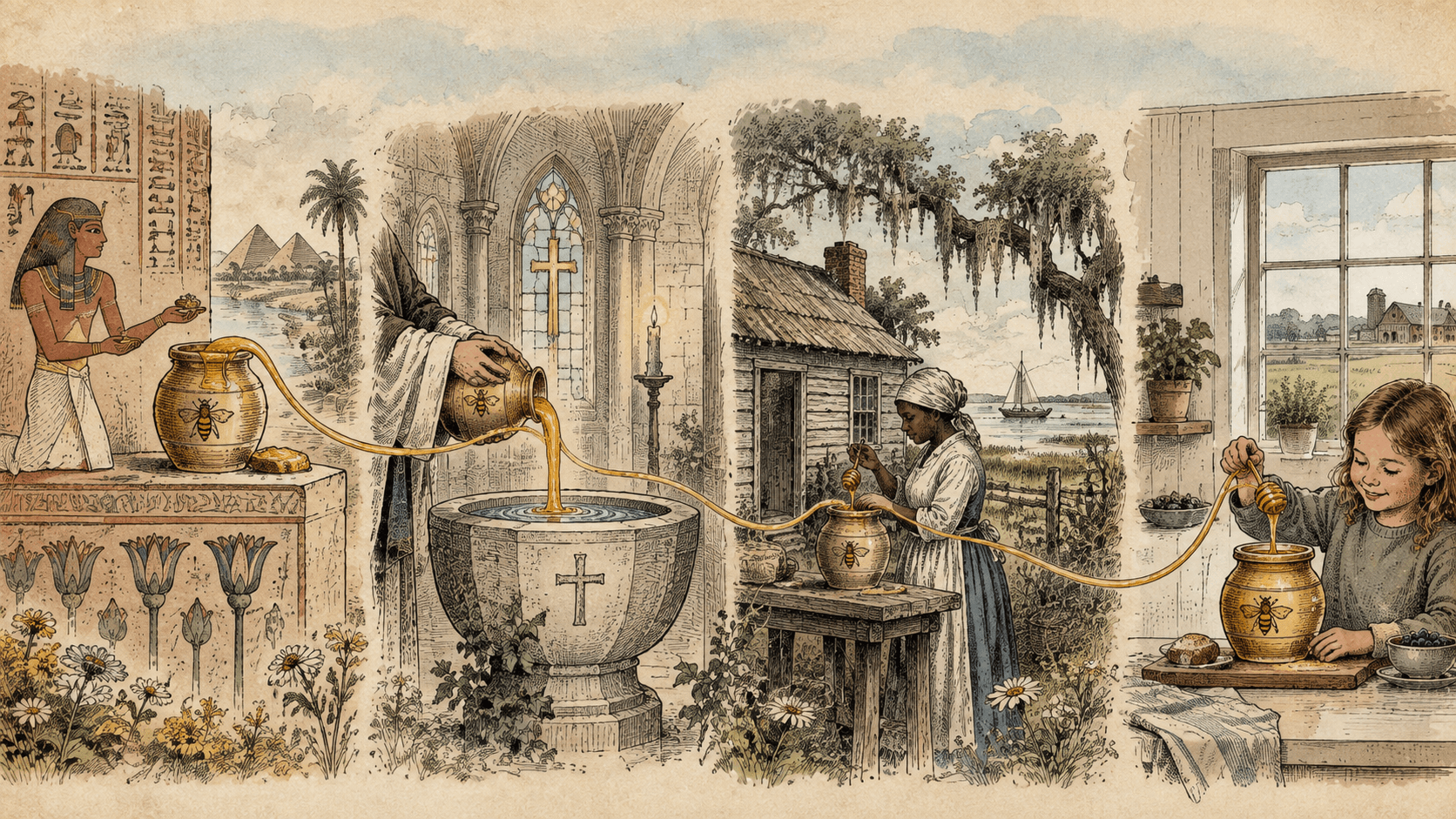
Casey starts this chapter from something ordinary: giving honey away, and a honey jar that keeps for years in a kitchen cabinet. Pharaohs were buried with honey on purpose, as provisions for a journey they believed was still ahead of them. (The chapter drops the popular story of edible honey found in a tomb and points ahead to chapter 28.) From there, the chapter argues that milk and honey aren't just old ingredients. They're one of the oldest paired images for crossing a threshold: an offering at Eleusis, a purification rite for Roman Mithraic initiates, a Hindu wedding sweet, and, closer to the church's own history, the cup handed to a newly baptized Christian in the Didascalia Apostolorum and the Canons of Hippolytus, meant to mark someone born again as a child. The Civil War thread carries the same image into American soil. Frederick Douglass wrote plainly that when enslaved singers repeated "O Canaan, sweet Canaan," they meant something more literal than heaven: the North was their Canaan, the land scripture itself describes as flowing with milk and honey. Missionaries collecting those songs on the Sea Islands during the war published them in 1867, in Slave Songs of the United States, without ever fully grasping what the people singing them meant to do about it. Swarms carry their own provisions for a crossing (they fill up on honey before they have picked where to go), and the land of Canaan really did have hives: the Tel Rehov apiary in the Jordan Valley, the oldest beehives yet found. On January 1, 1863, at Camp Saxton, an unplanned song took over the day Higginson had planned. Casey's point isn't that these traditions borrowed from each other. It's that none of them had to. The same image kept surfacing on its own, in a Greek rite, a Roman cult, a church font, and a cotton field, because 1 Peter 2:2's picture (a newborn craving milk to grow) describes something true enough that it didn't need translating.
Bee Science
- Ripe honey in a closed jar keeps for a very long time
- honey has too little water and too much sugar and acid for much to grow in it, so a sealed jar sits for years while bread molds in days and meat rots by morning. The popular story that archaeologists opened an Egyptian tomb and found honey inside still good to eat does not hold up (the manuscript points to chapter 28 for what was really in those jars); Pharaohs were still buried with honey on purpose, as provisions for a journey
- Honey vs. other foods
- a sealed jar of honey just sits there for years, while bread molds in days and meat rots by morning
- Swarms pack provisions before they choose a destination
- before a swarm leaves, the queen slims down so she can fly while workers fill up: in a dissection study most carried a drop or two of honey (35 to 55 milligrams), adding about half again to a bee's weight, so about a third of a departing swarm's weight is food. Wax glands swell in the same days because comb has to be made from honey. The loading builds gradually over about ten days before the swarm goes. The scouts pick the new home afterward, out on the branch, and every extra night uses up what the bees brought with them
- Tel Rehov, the oldest beehives yet found
- at Tel Rehov in northern Israel's Jordan Valley, archaeologists found three rows of unfired clay cylinders in a courtyard, each with a small hole at one end for the bees and a lid at the other for the beekeeper: about thirty found, a hundred to two hundred estimated. Two held charred honeycomb with bees embedded (workers, drones, pupae, larvae). The team dated them to the tenth or early ninth century BCE. The bees don't match the local Syrian honeybee; the only one they resemble lives in Turkey, about 500 kilometers north. The authors offered two explanations: the region's bees changed in three thousand years, or the town imported gentler, higher-yield bees
Cited research (3)
- Seeley, T.D., Honeybee Democracy (Princeton University Press, 2010): swarm engorgement (35-55 mg of honey, about one-third of swarm weight as food reserve), wax glands, and the cost of a delayed decision
- Combs, G.F. Jr. (1972), "The engorgement of swarming worker honeybees," Journal of Apicultural Research 11(3): 121-128: engorgement builds gradually over the ten days before a swarm leaves; abstract only read in the notes
- Bloch, G., Francoy, T.M., Wachtel, I., Panitz-Cohen, N., Fuchs, S. & Mazar, A. (2010), "Industrial apiculture in the Jordan valley during Biblical times with Anatolian honeybees," PNAS 107(25): 11240-11244: the Tel Rehov apiary; the authors' two explanations for the Anatolian match are both theirs
Scripture
Anchor: Romans 1:20
Also touches
Civil War Recordearly church
The early church's baptismal milk-and-honey rite (Didascalia Apostolorum & Canons of Hippolytus), set inside a cross-cultural threshold tradition, with the Sea Islands spirituals and Higginson's January 1, 1863 ceremony at Camp Saxton
- The Didascalia Apostolorum and the Canons of Hippolytus, both from the church's first few centuries, describe a real baptismal rite: a newly baptized Christian, still dripping, was handed a cup of milk and honey, "to teach the communicants that they are born a second time as little children"
- Milk-and-honey as a threshold image surrounds that rite in other cultures: at Eleusis, milk (and honey with it) was a customary offering poured out for the gods and spirits believed to live beneath the earth; Roman Mithraic initiates had their hands purified with honey at the "Lion" grade, per the philosopher Porphyry, who tied the practice to an older idea that bees were generated from the body of a dead bull; Hindu wedding and birth rites still use a honey-and-curds mixture called madhu-parka
- Two lesser-known ancient texts carry the same image: the Apocalypse of Paul (~4th century) has an angel guide Paul through the Land of Promise, where he finds four rivers (honey, milk, wine, and oil) and meets Isaiah, Jeremiah, Ezekiel, and the other prophets at the river of honey; Joseph and Asenath (date debated, 1st century BCE-4th century CE) has a convert, Asenath, fed a honeycomb by the Archangel Michael ("that comb is the spirit of life... whosoever shall eat of it shall not die for ever"), with white bees rising from the cells, verified against E.W. Brooks's translation
- During the Civil War, Frederick Douglass wrote in his 1855 memoir that the spiritual "O Canaan, sweet Canaan, I am bound for the land of Canaan" meant more than heaven to those who sang it: "We meant to reach the North, and the North was our Canaan" — verified verbatim against My Bondage and My Freedom (1855)
- Teachers and missionaries working among the newly freed people of South Carolina's Sea Islands during the war collected dozens of these songs, publishing them in 1867 as Slave Songs of the United States (manuscript wording as of the final text, which now reads "teachers and missionaries"; the older "missionaries and folklorists" wording is gone)
- Slave Songs of the United States has 136 songs from four regions, not one island. Union forces took the Sea Islands in November 1861 and the first teachers sailed the following March; William Francis Allen, the lead editor, did not leave New York until November 1863; Charles Ware was superintending a plantation at Coffin's Point; Lucy McKim Garrison was a musician in Philadelphia; and the book was still receiving material in the spring of 1867, weeks before publication (notes/research/slave-songs-of-the-united-states-1867.md)
- On January 1, 1863, at Camp Saxton near Beaufort, Thomas Wentworth Higginson, commander of the First South Carolina Volunteers (the first regiment of formerly enslaved men mustered into United States service), held a ceremony for the Emancipation Proclamation in a grove among live oaks; about five thousand people came, some by road and some on steamers. It began at half past eleven with the chaplain's prayer; Dr. W. H. Brisbane read the Proclamation ("a South Carolinian addressing South Carolinians"); the colors were presented; as Higginson took and waved the flag, an older man's voice and then two women's began "My Country, 'Tis of Thee," and he motioned the whites on the platform who joined in to silence. He wrote that "the life of the whole day was in those unknown people's song," and that spectators had been "waiting for my stupid words." Ten oxen were roasted whole on spits of young trees, with hard bread and molasses-water (three gallons of molasses, half a pound of ginger, and a quart of vinegar per barrel, a barrel per company), then dress parade (Higginson, Army Life in a Black Regiment, Camp Diary entry of January 1, 1863; notes/research/higginson-army-life-black-regiment-1869.md)
- In 1 Samuel 14:26 the Septuagint sends the men "into the place of the bees" and has them "continued speaking" where the Hebrew has honey oozing; S. R. Driver explained that the Greek translators' Hebrew apparently read d-b-r (to speak) rather than d-b-sh (honey), and read the same letters as "bees," giving "its bees had left it" (Brenton, 1844; Driver, Notes on the Hebrew Text of the Books of Samuel, 1890, pp. 85-86; notes/research/extraordinary-scripture-ancient-world.md and before-print-checks-2026-09-24.md, which moved the Brenton date from 1851 to 1844)
Primary sources (6)
- Didascalia Apostolorum; Canons of Hippolytus (cross-checked via notes/research/sacred-bee-ransome.md)
- Porphyry, On the Cave of the Nymphs (Mithraic honey-purification at the "Lion" grade)
- Frederick Douglass, My Bondage and My Freedom (1855)
- Allen, W.F., Ware, C.P. & Garrison, L.M., Slave Songs of the United States (1867)
- Thomas Wentworth Higginson, Army Life in a Black Regiment (Project Gutenberg edition, originally published 1869), Camp Diary, January 1, 1863
- Brenton, The Septuagint Version of the Old Testament (1844), 1 Kings (1 Samuel) 14:26; S. R. Driver, Notes on the Hebrew Text of the Books of Samuel (1890), pp. 85-86
verified
From the Book
Giving honey away is part of keeping bees for me. Every Christmas, each of my five kids' teachers gets a jar. By now, the teachers expect it. One of them has had every one of my kids, five for five. At orientation day, the first thing he said to me was, "I can't wait for Christmas." I asked him why. He said, "Honey." Visitors often leave with honey too. I still take a jar to my best friend's parents every year. He passed away, but Tim, his dad, tells me each time how much it means to him. The memory that first taught me honey is meant to be given away came before I ever kept a single bee of my own. Growing up, we had a commercial beekeeper's hives at the edge of our woods. The year we told him we were moving, he gave us extra honey. That was five full years before I caught my first swarm. Once, after I spoke at a church, I gave three pounds of it to a kid in the crowd. The kid had paid attention and answered every question I asked. The next time I came back to speak there, he handed me a drawing he'd made. It still hangs on my wall. One reason honey works so well as a gift is that it keeps. It doesn't behave like other food. Leave bread out and it molds in days. Leave meat out and it rots by morning. But a sealed jar of honey just sits there for years. You may have heard that archaeologists opened an Egyptian tomb and found honey inside still good to eat. That story doesn't hold up (chapter 28 has what was really in those jars). Ripe honey in a closed jar lasts a very long time. It has too little water and too much sugar and acid for much to grow in it. Pharaohs were buried with it on purpose, provisions for a journey they believed was still ahead of them.
Get the full book →