© 2026 Casey Spitnale
Chapter 20
The Hive's Risk
Faith in Action
“Deseret: A Beehive. May her inmates never cease their toil until the world is filled with honey, and her enemies with stings.”
Casey opens the chapter with an accident: a dropped frame, a jolt through the hive, guard bees stinging in seconds with no calculation involved. A worker's stinger is barbed. Once she uses it, she can't take it back, and she doesn't survive losing it. That single, irreversible commitment is what Casey lines up against Colonel Edward Baker riding into Ball's Bluff and Sergeant William Carney carrying the flag at Fort Wagner under fire that wounded him twice. The guard bee lives out Matthew 16:25 (whoever loses their life for something bigger finds it) without ever choosing it. Baker and Carney chose it, eyes open, the way John 12:24's kernel of wheat has to fall and die before it produces anything. Not every threat in the chapter looks like something a guard can meet at the entrance. Chalkbrood spread through Japan for years before anyone understood how it survived between outbreaks, and no sting stops a fungus. Casey reads that as its own kind of courage, the watchfulness 1 Peter 5:8 asks for against a threat that prowls rather than charges. The chapter's throughline lands on Daniel 3:17-18: Shadrach, Meshach, and Abednego telling Nebuchadnezzar their God could save them, but even if he doesn't, they still won't bow. That's the guard bee's clause too. She doesn't sting expecting to live. She stings because the colony behind her is worth more than the outcome in front of her.
Bee Science
- Sting autotomy
- a worker's barbed stinger anchors in the intruder, releasing venom and alarm pheromones; she can't withdraw it, and the loss of the stinger, venom sac, and part of her abdomen is a wound she doesn't recover from
- Alarm pheromone (isopentyl acetate)
- the "banana scent" released at a sting site calls other defenders to the same spot; the response runs to completion with no hesitation
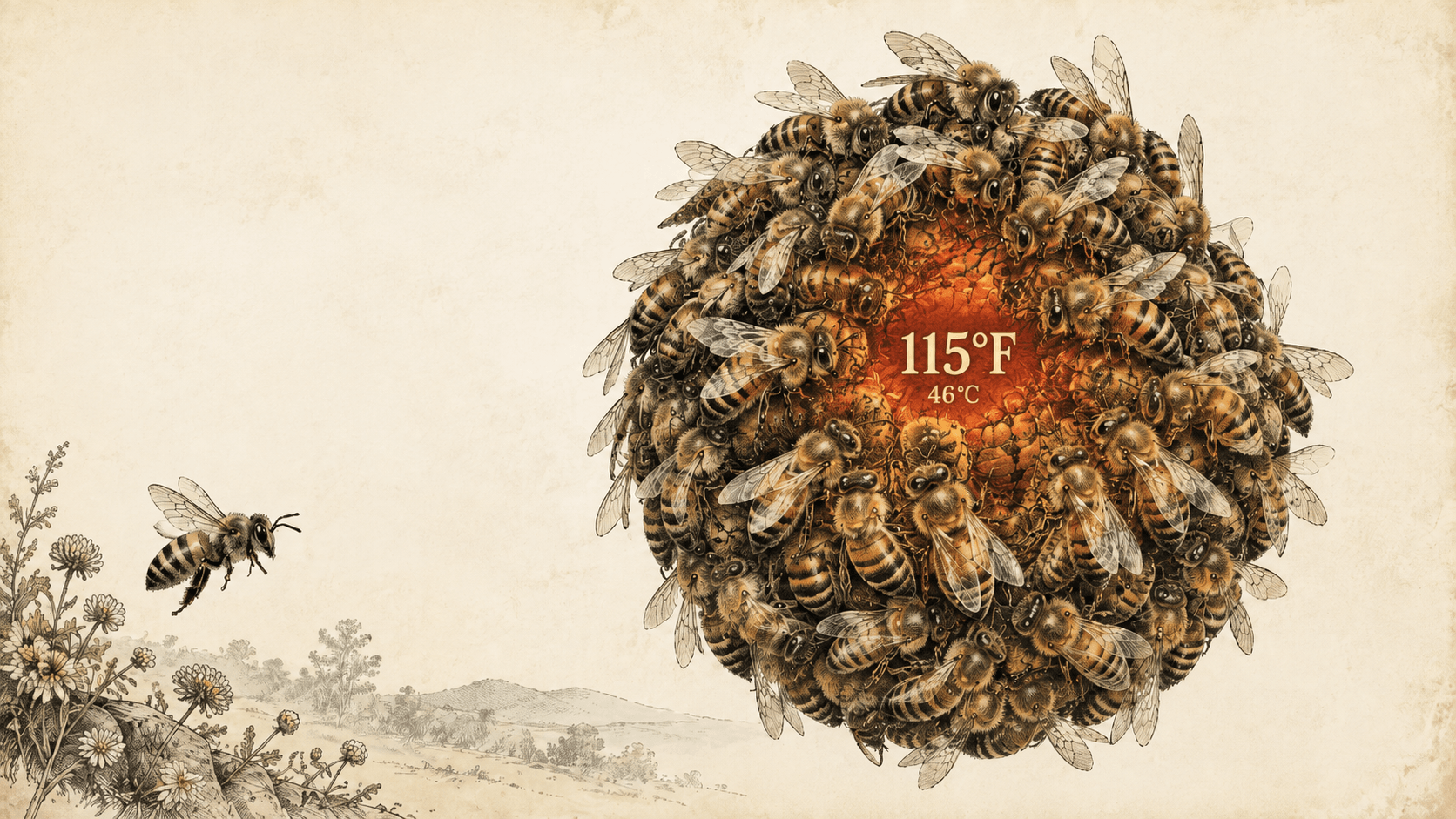
- Heat-ball defense
- a tight ball of workers smothers an attacking hornet with their own collective body heat; internal temperatures measured well above 110°F, hot enough to kill the hornet along with some defenders — most thoroughly documented in Japanese honeybees (Apis cerana japonica) against giant hornets; Casey's own bees are a different species but share the mobbing instinct at a smaller scale
- Chalkbrood's spread in Japan
- the fungus was first isolated there in 1974 from imported honey, an outbreak confirmed in 1979, and by 1982 it was turning up on three islands and spreading fast, with no cure, and fifty years after the fungus was first described almost nothing was known about how it lived in the wild
- Stinger loss and pursuit
- a bee can lose her sting before the threat is gone; alarm scent keeps calling defenders to the same spot, and she may keep pursuing the intruder for a while after losing it
- Shaken bees and pessimistic judgment (2011)
- honeybees trained that one blend of two smells meant sugar and the reversed blend meant something bitter or weak, then shaken hard for sixty seconds to simulate a predatory attack on a concealed colony, were more likely to take an unclear smell for bad news (a 'glass-half-empty' response) and had less dopamine, octopamine, and serotonin in their blood (chemical messengers tied to mood and reward); the authors make no claim about subjective feelings in honeybees
- Forager mortality in Algonquin Park (2007)
- of 611 tagged bees that became foragers in observation hives set in a trailer in Ontario's Algonquin Park, average life once flying was a little under a week; beyond the effects of age, a steady death rate of about 13 percent a day, most of it attributed to predators
- Foragers weighing risk (British Columbia meadow)
- given two equally sweet artificial flowers, one with a freshly killed bee beside the syrup, nineteen of twenty foragers landed on the other; after a rubber spider was swung at an arriving bee only one in ten returned within ten minutes (nine in ten of untouched bees came back), yet every one of the scared bees turned up again at the feeder, all but one within the hour
- Yellow-legged hornet and foraging paralysis
- the yellow-legged hornet hovers at hive entrances and picks off foragers; colonies answer by shutting down flights, and in models this foraging paralysis was an important part of why hornet-pressured colonies in France died over winter; muzzles (wire cages over the entrances so hornets could not hover right at the door) on 22 hives (each paired with an open one) did not cut the number of foragers taken but got colonies flying again, which alone raised survival chances in simulations
Cited research (7)
- Boch, R., Shearer, D.A. & Stone, B.C. (1962), "Identification of Isoamyl Acetate as an Active Component in the Sting Pheromone of the Honey Bee," Nature 195:1018-1020: identified isopentyl (isoamyl) acetate as the sting alarm pheromone — the real source behind this chapter's "banana scent" detail and ch.9's parallel claim
- Papachristoforou, A. et al. (2007), Current Biology: documents A. mellifera cypria balling and heat-killing Vespa orientalis hornets, backing the claim that Casey's own (different) species shares the mobbing/heat-ball instinct
- Cunard, R.L. & Breed, M.D. (1998), Annals of the Entomological Society of America: Bees can keep pursuing an intruder after losing the sting; alarm scent keeps calling defenders to the same spot
- Bateson, M. et al. (2011), Current Biology (Newcastle University): Shaken honeybees showed a pessimistic judgment bias and lower dopamine, octopamine, and serotonin; the authors say the results 'call into question how we identify emotions in any nonhuman animal'
- Dukas, R. (2001, 2008): 2008: forager mortality of about 13% a day in Algonquin Park; 2001: foragers weigh predator cues (dead bee at a flower, rubber spider) but keep returning
- Requier, F. et al. (2019, 2020): Foraging paralysis under yellow-legged hornet pressure and its role in winter colony loss; entrance muzzles restored flights
- Furuya (1982), Honeybee Science (Mitsubachi Kagaku, Tamagawa University): Japanese-language mycology review tracking chalkbrood's 1974-82 spread through Japan; read via the author's own English summary, no direct quotes available
Scripture
Anchor: Romans 1:20
Also touches
Civil War Recordcivil war
Colonel Edward D. Baker at Ball's Bluff and Sergeant William Carney at Fort Wagner
- Colonel Edward D. Baker, the only sitting U.S. Senator ever to die in combat, led roughly 1,700 Union soldiers across the Potomac at Ball's Bluff (a steep, wooded bank above the Potomac, upriver from Washington), Virginia, on October 21, 1861, into a tactically disadvantageous position against a superior Confederate force
- Baker's attested remarks hold up under verification: that the officer who dies with his men will never be harshly judged, and, to a soldier who suggested he take cover, that once you're a United States senator, you won't lie down either; he was struck by several bullets, including a fatal shot to the head, per Captain Francis Young's account, preserved in the Official Records of the war (the government's published collection of battle reports)
- Sergeant William H. Carney, 54th Massachusetts Infantry, earned the first Medal of Honor action by an African American soldier, the July 18, 1863 assault on Fort Wagner, South Carolina (a Confederate sand-and-log fort guarding the approach to Charleston harbor); the medal itself was not awarded until May 23, 1900, after other Black soldiers had already received theirs
- Carney's actual Medal of Honor citation reads: "When the color sergeant was shot down, Sergeant Carney grasped the flag, led the way to the parapet, and planted the colors thereon. When the troops fell back he brought off the flag, under a fierce fire in which he was twice severely wounded." His remembered remark, "Boys, I only did my duty; the old flag never touched the ground," is the line his name has carried since, not itself part of the citation text; The Liberator, the abolitionist newspaper, carried word of his courage that same August 1863
- Chicago Mercantile Battery (Mary Livermore's own Chicago church sent thirty young men into it): on April 8, 1864, two miles short of Mansfield, Louisiana, at the extreme front of a Union column strung out along one narrow road, the battery was hit by ten thousand Confederates on both flanks and in front; Lt. George Throop, exempt from service because he had lost a finger and whose parents had just buried another son, was mortally wounded by a shell fragment and ordered the men back to their guns ('I give my life for a glorious cause, and I do not regret it'); Sergeant Dyer was shot through the lungs spiking his gun (driving a spike into its firing hole so the enemy could not turn it on the men behind him); every gun was lost and of a hundred and ten horses forty-five came off the field; a mile back the Nineteenth Corps opened its ranks for the rout and stopped the pursuit; Livermore counts the cost of the day at three thousand men and twenty pieces of artillery (Livermore, My Story of the War, 1889)
- John Richardson (48th Ohio, most of which was captured at Mansfield) spent the next six months as a prisoner at Camp Ford, near Tyler, Texas (Montgomery, National Tribune, October 13, 1887, transcribed at 48ovvi.org); on October 25, 1864 he wrote that scurvy had loosened his teeth, 'but thank God i am alive yet' (Richardson letters, transcribed at 48ovvi.org)
- Clara Barton (who would later found the American Red Cross) left Antietam in September 1862 with a bullet hole in her sleeve she never mended; permission to carry supplies to the front herself came in July 1862; on September 17 she followed the guns to the north end of the field, where about three hundred wounded lay by a farmhouse and barn with 'not a bandage, rag, lint, or string'; a bullet passed between her and a man she was giving a drink and killed him. At Fredericksburg in December a surgeon's note reached her ('Come to me. Your place is here'), she crossed on the pontoon bridge (a roadway laid across a line of boats) under fire, and a shell piece passed between her and an officer who was brought to her dead within half an hour; in June 1863 at Hilton Head she described her business as 'stanching blood and feeding fainting men; my post the open field between the bullet and the hospital,' and she nursed the wounded from the Fort Wagner assault on Morris Island (W. E. Barton, The Life of Clara Barton, 1922; Epler, The Life of Clara Barton, 1915)
Primary sources (4)
- Congressional Medal of Honor Society, recipient page for William Harvey Carney (cmohs.org/recipients/william-h-carney)
- Official Records of the War of the Rebellion (Captain Francis Young's account of Baker's death at Ball's Bluff)
- The Liberator, August 1863
- Livermore, My Story of the War (1889); Richardson letters and Montgomery, National Tribune (1887), transcribed at 48ovvi.org; W. E. Barton, The Life of Clara Barton (1922); Epler, The Life of Clara Barton (1915); notes/research/clara-barton-field-service-1862-63.md
verified
From the Book
One summer day, I dropped a frame heavy with honey during an inspection. Within seconds, defenders were all over it, wings humming, and I could smell bananas. That's the alarm pheromone. Several bees drove their stingers into my gloves. They were defending the colony from what they'd taken for an attack. I knew it was an accident. They had no way to know that. When a worker stings, her barbed stinger catches in the intruder's flesh. It releases venom and alarm pheromones. Other defenders follow the scent to the same spot. She pulls away, leaving the stinger, venom sac, and part of her abdomen behind. She doesn't recover from that wound. Guard bees don't hesitate anyway, even against threats many times their size. People have made that trade on purpose. Colonel Edward D. Baker made it at Ball's Bluff, a steep, wooded bank above the Potomac River, upriver from Washington. Baker was the only sitting U.S. Senator ever to die in combat. On October 21, 1861, he led roughly 1,700 Union soldiers across the Potomac River. They found themselves in a tactically disadvantageous position facing a superior Confederate force. When urged to fall back, Baker is remembered as saying that the officer who dies with his men will never be harshly judged. He reportedly told one soldier who suggested he take cover that once you're a United States senator, you won't lie down either.
Get the full book →