© 2026 Casey Spitnale
Chapter 19
The Silent Symphony
Feeling God's Voice
“There is the hum of contentment and the hum of trouble, the hum of peace and the hum of defence, the hum of plenty and the buzz of starvation, the hum of joy and the roar of grief, the cry of pain and the music of their dance.”
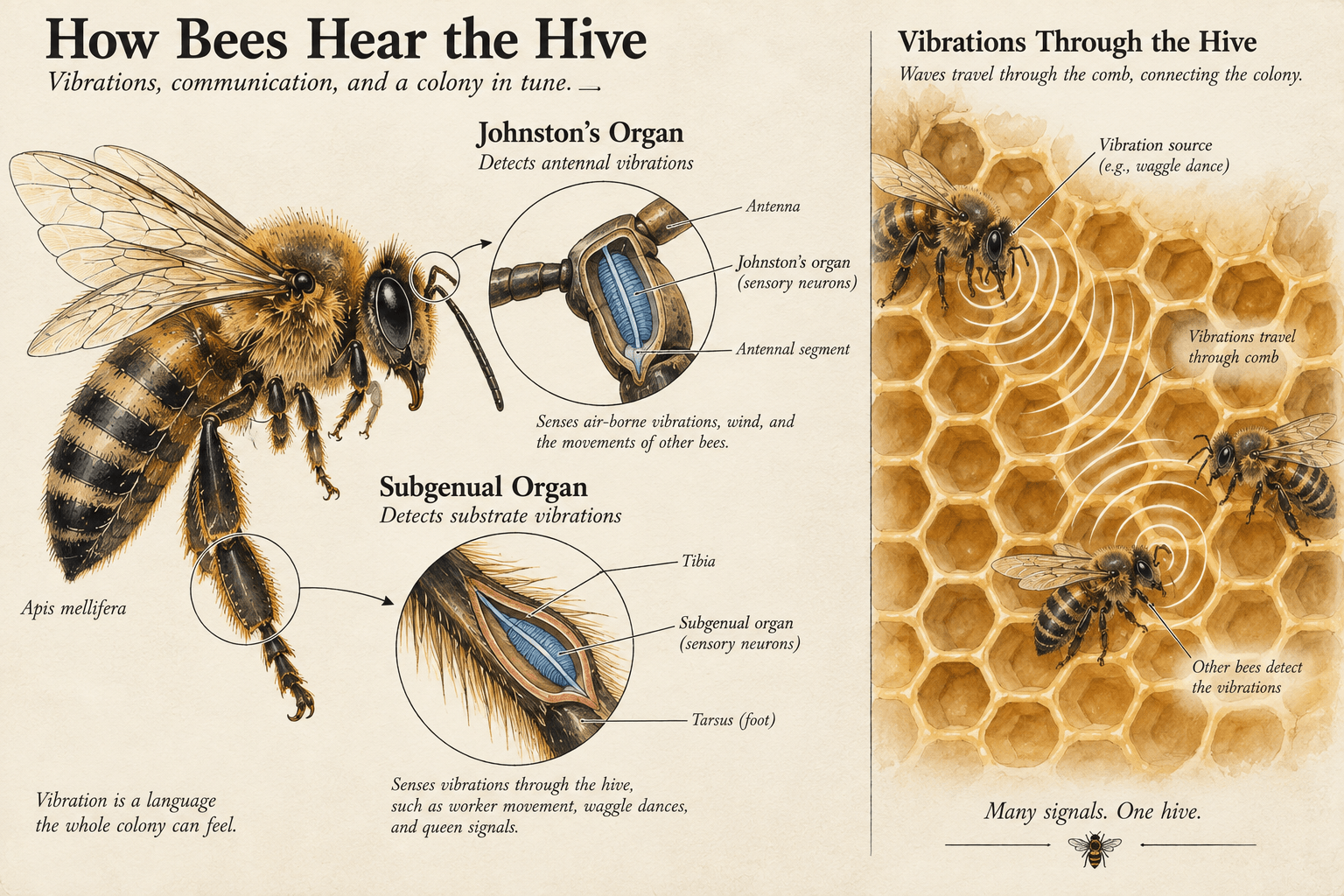
Casey builds the chapter around one question: what does it take to actually notice a signal that's already there? Bees never evolved ears built for distance. Johnston's organ only picks up air moving close around a bee's own body, tuned near the frequency of her own wingbeat. Anything farther off has to travel a different way, through the comb and up through the subgenual organs in her legs. Casey sets that against A.E. Lundie's 1922 flight counts: a colony emptying the field hours before a storm that built all afternoon and never broke, and an undisturbed hive's own flight counts spiking forty percent the moment a colony thirty-six feet away was disturbed. Nothing in either hive was built to hear that far. Something in the colony still read it. Edward Porter Alexander's wig-wag warning at First Manassas makes the same point. Nobody down on the field could see what he saw from his signal-station hilltop. He was positioned to notice, and trained to get the warning across before the moment closed. That's the pivot into 1 Kings 19, where God turns up not in the wind, the earthquake, or the fire, but in a whisper only after all three have passed. Elijah had to learn to expect that. Samuel, back in 1 Samuel 3, needed three tries before Eli worked out what was happening and told the boy what to say. Casey's point isn't that God is quiet by nature. It's that most of what matters comes in at a scale too small for someone still listening for something loud. The chapter also gives the quieter signals their due. One is a short buzz that tells a dancing bee to stop, which James Nieh found bees send more when a feeder turns dangerous. Casey sets it beside Paul in Acts 16, stopped twice before a vision sent him to Macedonia, to make a simple point: some signals call us forward, and some save us by stopping us.
Bee Science
- Johnston's organ hearing range
- a narrow slice of near-field airborne sound, tuned to roughly 250-350 Hz (vibrations per second) — close to a bee's own wingbeat and waggle-dance frequency
- Subgenual organs (leg vibration sense)
- sensors just below the knee joint of each leg detect vibration traveling up through the comb — a bee's channel for anything farther off than close-range sound
- 1922 threatened-storm response
- at the height of an afternoon storm that built, thundered, and never dropped a drop of rain, all but thirteen of the bees out foraging had come home, hours before weather a person would have run from
- 1922 neighbor-disturbance spike
- when a colony 36 feet away was disturbed until the air over it was as thick with bees as a swarm on the wing, an undisturbed hive's own flight counts spiked about 40% above normal, ingoing and outgoing both, at the same moment
- Queen tooting and quacking
- in 2020 accelerometers (motion sensors like the ones in a phone) set into the comb recorded whole swarming seasons: in unopened hives there was no piping for four to seven days after the old queen left with the swarm, then toots from the loose queen with quacks from the sealed cells answering within hours; the duet ran until the loose queen left with an afterswarm (a second, smaller swarm), and in all the recordings two queens never tooted at the same time; in hives beekeepers kept opening, the order fell apart, and the researchers think a sealed queen may finish her cut and walk out early into a hive that already has a queen loose
- The vibration signal
- a worker grabs a sister with her front legs and shakes her body up and down for a second or two, then moves on, as many as twenty or more sisters a minute; its message is 'increase your activity'; results usually take fifteen to thirty minutes to show; a shaker touches hundreds of sisters and shakes fewer than half of them; on one frame the Nottingham team counted an average of 339 shakes an hour on video, most too faint to hear, with more at night than by day
- Tanging a swarm
- beating on pans or metal to settle a swarm is called tanging; Virgil told beekeepers to raise a ringing and clash cymbals around a swarm, and Aristotle heard that men brought bees home by striking earthen pots and doubted it; Casey banged two hive tools together when a swarm came out, the bees went back into the hive, and he has it on video; the chapter treats it as one more signal bees catch that people miss, without claiming a mechanism
- Stop signal and danger (Nieh 2010)
- a worker butts a dancing sister and gives a short buzz, well under a fifth of a second, called the stop signal; a dancer who gets enough of them dances less and quits sooner; at a feeder where foragers from rival colonies fought, attacked bees came home and gave forty-three times as many stop signals as before, and an imitated predator's bite on a forager raised it eighty-eight-fold; signalers aimed at sisters who smelled like the same feeder
- Washboarding
- bees line up on the front of the hive and rock forward and back in place; they are workers starting around thirteen days old, most fifteen to twenty-five; researchers at the USDA bee lab in Beltsville, Maryland pinned down the age and time of day and still could not say why they do it; nobody knows
Cited research (7)
- Dreller, C. & Kirchner, W.H. (1993), "Hearing in honeybees: localization of the auditory sense organ": established Johnston's organ, in the antennae, as the site of airborne-vibration detection
- Tsujiuchi, S. et al. (2007): found antenna/Johnston's-organ neurons tuned to 250-300 Hz, matching waggle-dance frequency
- Sandeman, D., Tautz, J. & Lindauer, M. (1996), "Transmission of vibration across honeycombs and its detection by bee leg receptors," Journal of Experimental Biology: documented leg-receptor (subgenual organ) detection of comb-transmitted vibration
- Lundie, A.E., USDA Bulletin 1328 (1925), The Flight Activities of the Honeybee: electric-gate flight counters on a Maryland colony (1922) recorded the storm-response and neighbor-disturbance spikes; Lundie's own line: "it is interesting to speculate as to the method of conveyance of the information to the bees within the experimental colony"
- Ramsey, M.-T. et al. (2020), Scientific Reports 10:9798, and Ramsey, Bencsik & Newton (2018), Scientific Reports 8:14571: Comb accelerometers on queen tooting and quacking through swarming seasons, and on the vibration (shaking) signal on the comb
- Schneider, S.S. & Lewis, L.A. (2004), Apidologie 35:117-131: The vibration signal, whose whole message is 'increase your activity'
- Tautz, J., The Buzz about Bees (2008): describes the honeycomb itself as a communication medium, carrying vibrations through wax at frequencies close to a bee's own wingbeat
Scripture
Anchor: Romans 1:20
Also touches
Civil War Recordcivil war
Edward Porter Alexander's wig-wag warning at First Manassas, July 21, 1861
- Alexander, a young Confederate officer, had trained under Albert J. Myer, inventor of the U.S. Army's new "wig-wag" flag-signaling system — a method almost nobody yet trusted in actual combat
- Posted on a signal station hilltop at First Manassas (First Bull Run), July 21, 1861, Alexander caught a glint of sunlight on distant metal and made out a Union column moving to outflank the Confederate left, coming around the end of the line where nobody was facing, a threat the generals on the ground couldn't yet see
- He wig-wagged the warning across the field — remembered as "Look out for your left; you are turned" — giving Confederate commanders time to shift their line before the flanking blow landed; it's remembered as the first tactical use of flag signaling in American combat
- The exact wording of the signal varies slightly across period and secondary sources ("Look out for your left, your position is turned" / "Look to your left, you are turned"), which is normal for a widely-quoted 1861 battlefield signal, not a sign of fabrication
- Alexander's warning was received by Col. Nathan Evans, whose brigade held that end of the Confederate line, and who moved on it
- Philip Hayes's 103rd Ohio spent its first weeks in Kentucky being woken by warnings that the rebels were coming; the alarms proved so often empty that 'the thing finally got to be an old story, and we learned to turn out in a more deliberate manner'; a civilian's report that five hundred Confederate cavalry would attend a colonel's funeral sent the regiment fifteen miles to find 'the only rebel soldier we found was the one who was being buried'; by that winter cavalry-in-the-rear reports were unreliable 'in nine cases out of ten,' and the army was pulled back from Dandridge on 'some mere rumor' that the Confederate general James Longstreet was crossing the river when he was in fact marching the other way (Hayes, 1872)
- Seven Pines, May 31, 1862: Gen. Joseph Johnston, the Confederate commander defending Richmond, held his reserves at Old Tavern, ten miles east of Richmond; the fighting began around one in the afternoon and he heard nothing for about three hours, although Richmond and Federal troops to the east heard it; a desperate note from Longstreet at four o'clock convinced him; he sent the reserves in too late, was wounded that evening, and was out of the war for almost six months; Lee took the army the next afternoon
- Physicist Charles Ross attributes the silence to a temperature inversion, after a violent thunderstorm the night before and low, spreading cloud that morning, bending the sound back to the ground farther off; the manuscript explains an inversion as a lid of warm air sitting over cooler air (Ross, 'Outdoor Sound Propagation in the U.S. Civil War,' Echoes, Acoustical Society of America, Winter 1998)
- An earlier draft's version of this anecdote (a fabricated "knock code" episode) has been fully replaced by this verified First Manassas story; no trace of the fabricated version remains in the live manuscript text (confirmed 2026-09-09 and again 2026-09-16)
Primary sources (6)
- Hayes, Journal-History of the Hundred & Third Ohio Volunteer Infantry (Bryan, Ohio, 1872), as cited in manuscript ch.19; notes/research/hayes-103rd-ohio-journal-history-1872.md
- Ross, Echoes (Acoustical Society of America), Winter 1998; notes/research/ross-acoustic-shadows-lecture.md (Applied 2026-09-24, Casey approved: ch.19 Seven Pines passage follows Ross's published account)
- Virgil, Georgics IV (Fairclough trans. 1916, p. 207; Fairclough's note, pp. 206-207, corrected from p. 207 per notes/research/before-print-checks-2026-09-24.md); Callimachus, Hymn to Zeus (Mair trans. 1921, p. 43); Aristotle, History of Animals IX (Cresswell trans. 1862); notes/research/tanging-sources.md
- Infantry Tactics (the 1862 manual from the forager chapter): 'The colonel will cause the fire to cease by the sound to cease firing' (quoted in manuscript ch.19; no notes/research entry for this passage, source edition not re-checked here)
- Pettigrew, The Handy Book of Bees (1875), on queen piping and the sealed queens' answering calls
- notes/research/citation-fixes-2026-09-09.md (2026-09-09 verification pass): confirms Alexander trained under Myer, was posted on Signal Hill at First Manassas, and signaled a warning to Col. Nathan Evans
verified
From the Book
The boy Samuel heard his name three times in the night before anyone in the house understood what was calling him. Twice he ran to Eli, the old priest lying in his usual place, and twice Eli sent him back to bed. It was only on the third time that "Eli realized that the Lord was calling the boy," and he told him what to say if it happened again: "Speak, Lord, for your servant is listening" (1 Samuel 3:8-9). The priest, who had spent his life in that house, wasn't the one who heard. The boy heard it first. Eli helped him understand who was calling. Bees don't have ears like ours. No eardrum or cochlea. But they can detect nearby movements of air through sensors in their antennae called Johnston's organs. Those sensors respond strongly around 250 to 350 Hz, or vibrations per second, close to the frequencies of wingbeats and the waggle dance. That's close-range hearing, built for a world where the only sounds worth catching are the ones a sister makes a few inches away. For anything farther off, they switch senses entirely. They feel vibration travel up from the comb through their legs. They use subgenual organs, sensors tucked just below the knee joint of each leg. A bee doesn't hear a warning from across the hive so much as feel it arrive through the floor she's standing on.
Get the full book →