© 2026 Casey Spitnale
Chapter 18
The Bee's Body
Clothed in God's Armor
“Go to the bee, thou poet: consider her ways and be wise.”
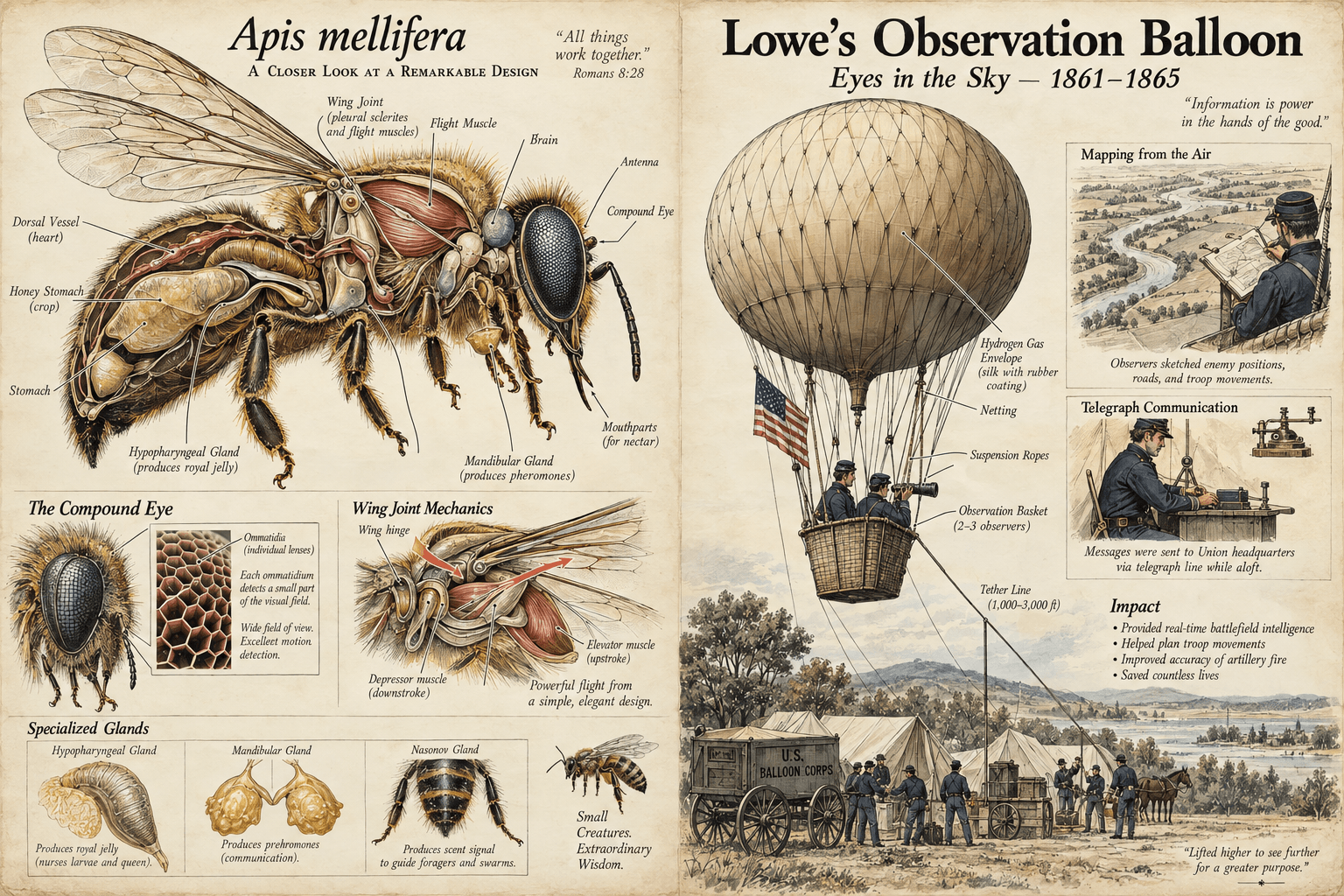
Thaddeus Lowe's balloon corps worked because it was never just a balloon. Portable hydrogen generators, an observation platform, and a telegraph line back to headquarters had to function as one integrated system before Lowe's aerial view meant anything on the ground. Take away any one piece and the intelligence never reaches the army in time to matter. Casey builds the chapter's anatomy section the same way. A bee's two compound eyes, each with thousands of lenses, work alongside three simple eyes on top of her head that read light levels and keep her steady in flight: five eyes, not two, each doing a different job. Her antennae read scents, including her colony's own. None of those parts protects her on its own. They function as a single system, the same way Lowe's generators and gasbags and telegraph wire only mattered together. That's the shape Casey finds in Ephesians 6:10-17's full armor of God: not one piece of equipment but a complete system, belt and breastplate and shield and sword, meant to be worn as a whole. A bee doesn't get to rely on her eyes alone or her wings alone. She's covered, part by part, into one working design, and Casey reads that completeness as the point Paul was making too: armor only protects when none of it is missing.
Bee Science
- Eyes
- two large compound eyes with thousands of lenses that detect ultraviolet patterns on flowers, plus three smaller simple eyes (ocelli) on top of the head that read light levels and help keep her steady in flight: five eyes, not two
- Antennae and exoskeleton
- antennae help her recognize scents, including the chemical signature of her own colony; the hard exoskeleton has plates that let her move while protecting what is inside
- Thorax as flight engine
- the thorax carries all six legs and both pairs of wings, joined in flight by hooks called hamuli; the main flight muscles run front to back and top to bottom and change the shape of the thorax, and the wings move as its walls flex, acting on the thorax 'as a whole and not directly upon the wings themselves' (Snodgrass is the government entomologist who wrote the classic Anatomy of the Honey Bee)
- Hovering wingbeat and stroke
- hovering foragers beat their wings about 230 times a second through an angle of about 91 degrees; in a helium mixture with air density like that above the top of Everest they barely sped up but widened each stroke to about 132 degrees; the researchers suggested the reserve might help with loads and left room for other explanations
- Foot pad on glass
- on rough surfaces the claws catch and stop the pull before the pad fully unfolds; on glass the claws slip, the pull continues, and the pad opens and holds with a sticky film; the claws and pad share a tendon
- Cuticle still developing at emergence
- under an electron microscope, the abdominal cuticle (the material the outer covering is made of) of newly emerged workers was less than half as thick as a forager's and kept thickening over the next three or four days; solitary bees compared with honeybees emerged with cuticle already developed; foragers also had more of the outer compounds that help keep a bee from drying out
- Colony thermoregulation
- flight muscles can produce heat while the wings stay still; when brood is present the colony works to hold the brood nest around 91 to 97°F, workers helping supply the warmth with their own bodies, and in hot weather they carry water and fan to cool the hive
Cited research (6)
- Snodgrass, R.E. (1910), The Anatomy of the Honey Bee, USDA Bureau of Entomology Technical Series No. 18: Thorax as the flight engine (great muscles acting on the shape of the thorax) and the sticky adhesive pad between the claws; the government bulletin, not the 1956 book of nearly the same title
- Altshuler, D.L. et al. (2005), PNAS 102(50):18213-18218: Hovering honeybees: about 230 beats a second at about 91 degrees, widening to about 132 degrees in low-density air
- Federle, W., Brainerd, E.L., McMahon, T.A. & Hölldobler, B. (2001), PNAS 98(11):6215-6220: High-speed video of bees walking upside down on glass: the shared claw-and-pad tendon lets the pad unfold on smooth surfaces where the claws slip
- Falcón, T. et al. (2019), PLoS ONE 14(3):e0213796: Honeybee cuticle matures after emergence (newly emerged abdominal cuticle under half a forager's thickness), unlike the solitary bees compared
- Stabentheiner, A., Kovac, H. & Brodschneider, R. (2010), "Honeybee colony thermoregulation," PLoS ONE 5:e8967: Colony-level endothermy: shivering flight muscles hold the brood nest at a stable temperature independent of outside weather
- Furuya, Kouhei (1982), Honeybee Science (Mitsubachi Kagaku) 3(2): Chalkbrood fungi grew in laboratory cultures in warmth and sugar-rich conditions, so a hive's warmth and food alone are not complete protection for larvae (the manuscript is explicit that keeping brood warm does not cause chalkbrood); worked from the author's English summary and numeric tables, no direct quotes (Japanese-language paper)
Scripture
Anchor: Romans 1:20
Also touches
Civil War Recordcivil war
Thaddeus Lowe and the Union Army's Balloon Corps
- Lowe demonstrated military ballooning to Lincoln on June 16, 1861 (per Library of Congress dating), ascending 500 feet above Washington and sending a telegram from the air: 'This point of observation commands an area nearly fifty miles in diameter. The city with its girdle of encampments presents a superb scene'
- When military bureaucracy stalled Lowe's formal appointment, Lincoln personally intervened with a July 25, 1861 note to Gen. Winfield Scott: 'Will Lieut. Genl. Scott please see Professor Lowe, once more about his balloon.' Lowe was appointed Chief Aeronaut of the Union Army's new Balloon Corps later that summer
- Lowe developed portable, wagon-mounted hydrogen generators for rapid field deployment; his technical drawings are preserved in the Smithsonian Institution Archives, and Joseph Henry sponsored the work
- Union cavalry began the war with a single-shot carbine (the short rifle cavalry carried); by 1864 many carried the Spencer, which held seven shots, loaded through the butt, and fired as fast as a man could work the lever; Confederates facing it coined the line that the Yankees 'loaded on Sunday and fired all week' (Facts about the Civil War, Civil War Centennial Commission, 1960)
- During the Peninsula Campaign (the Union's 1862 push up the Virginia peninsula toward Richmond), Brig. Gen. Fitz John Porter's tether snapped during a reconnaissance ascent and he drifted over enemy lines, continuing to sketch enemy positions until a wind shift let him valve gas and descend safely back over Union territory
Primary sources (5)
- Lincoln Papers, Library of Congress (June 16, 1861 telegram; July 25, 1861 note to Scott)
- Lowe's official report, Official Records, Series III, Vol. 3
- Smithsonian Institution Archives (Lowe's technical drawings)
- notes/chapters/citations.md, Ch.16 section
- Facts about the Civil War, Civil War Centennial Commission (1960) (Spencer carbine line, manuscript ch.18 inline)
verified
From the Book
One summer afternoon I scooped an exhausted forager off the landing board. Her wings were frayed. Pollen still dusted her legs. Look at how small a bee is. Then think about what she carries around. Eyes that see colors we can't. Antennae that recognize her sisters. Wings that carry her out to find food and bring her home with it. All of that fits in something I could lose in a coat pocket. And most of us just want her to get away from our sandwich. I understand. I spent my childhood trying to get away from bees. Now I keep looking closer, and there is always something else to see. God put a lot into this little creature.
Get the full book →