© 2026 Casey Spitnale
Chapter 17
Propolis
Armor Against Evil
“A kind of cement used in hives to fill up all holes and cracks, and prevent unnecessary ventilation... a sort of resin or gum, sometimes called bee-glue... collected from the buds of poplar and other trees.”
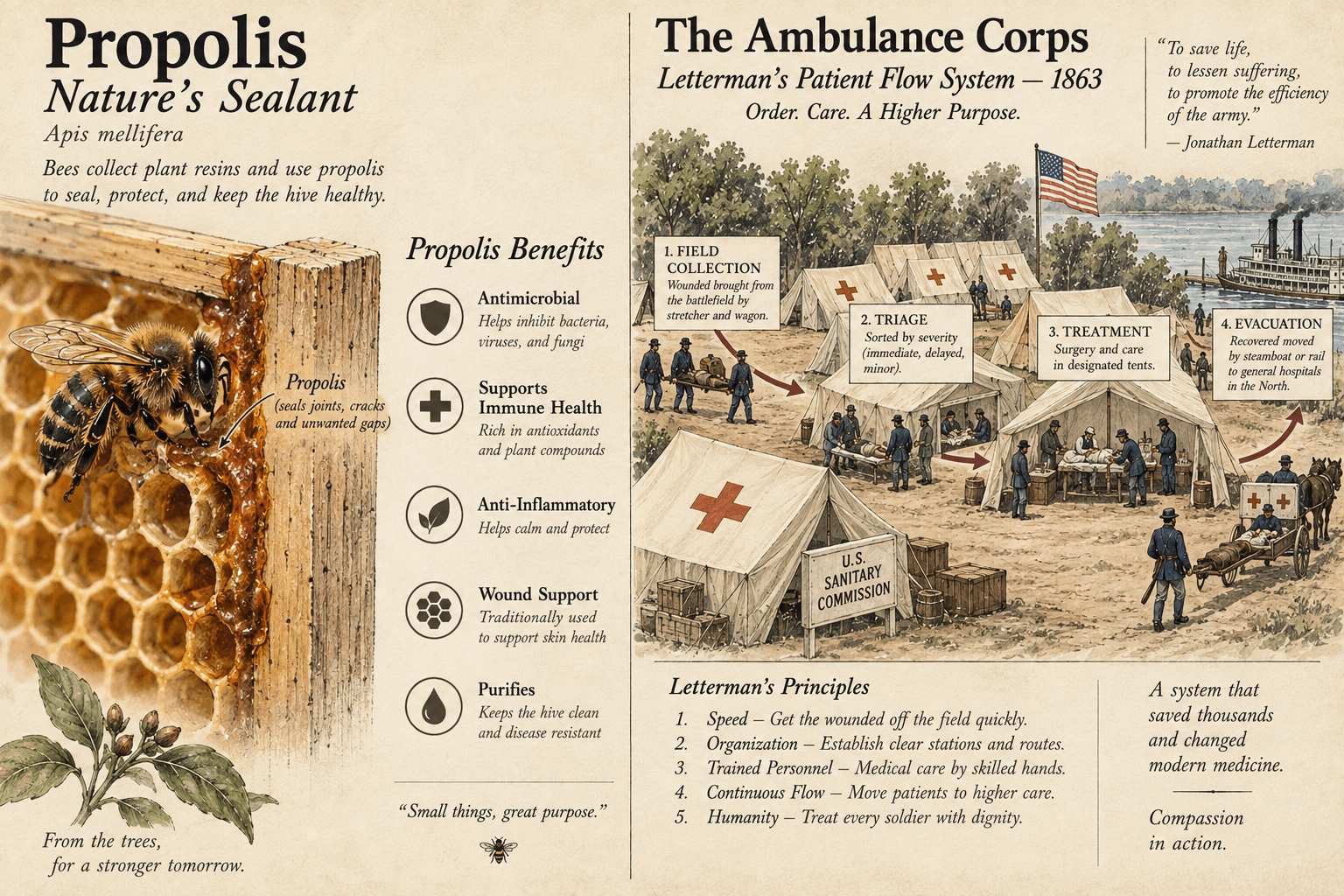
Propolis doesn't act like a wall so much as a nervous system for the whole colony. Colonies coated in it show lower individual immune-gene activity than colonies without it, meaning the protection is working at the level of the hive, not bee by bee. No single bee has to fight off more because the colony built the defense in ahead of time, into every seam and crack. Casey draws the same shape out of Jonathan Letterman's ambulance system. Before Letterman's reforms, wounded men could lie on a battlefield for days waiting for help that didn't exist yet as an organized thing. Three weeks after General Orders No. 147 created the Army of the Potomac's first real ambulance corps, Antietam produced more than 23,000 casualties, and nearly every wounded man was off the field within about a day. No soldier got braver in those three weeks. The system around him changed, and that change protected men individually who never did anything differently themselves. That's the case Casey makes from Ephesians 6:16 and the shield of faith: protection isn't always something you can see doing its work, or something that only shows up in the moment of attack. Elisha's servant needed his eyes opened just to notice the protection that already surrounded him. A hive sealed in propolis, an army with an evacuation system in place, a servant standing in a ring of fire he can't yet see: none of them fought harder. They were already covered.
Bee Science
- Propolis compounds identified
- more than 300 chemical compounds, including antimicrobial flavonoids like pinocembrin and galangin
- Social immunity
- colonies in boxes coated inside with a propolis extract showed lower individual immune-gene activity than colonies without it, which suggests propolis lets a colony conserve biological energy by reducing the need for individual immune responses
- Resin foragers are rare and slow
- at any given time fewer than one forager in a hundred is out collecting resin; they go mostly between midmorning and midafternoon on sunny days; reported loading times run from about seven minutes to an hour; a resin forager cannot gather pollen on the same trip
- Cementing bees and the tremble dance
- a resin forager cannot unload herself; she waits at the spot where propolis is needed while cementing bees bite chunks off her legs and stick them to the wall (cementing bees are house bees that do the hive's plastering, taking resin other bees bring in and putting it where it is needed); the wait usually runs about fifteen minutes but can run one to seven hours or all night; in one close study about a quarter of resin foragers did a shaking 'tremble dance' that seems to signal others to take the resin
- Finding gaps by feel
- in the dark hive, bees find gaps by walking along a seam and pushing an antenna into it; resin foragers learned the feel of a gap between two metal plates, and rough sandpaper, better than pollen foragers did, while both groups learned a smell equally well; in a hollow tree a colony coats the cavity with a propolis envelope a third to half a millimeter thick, while in a smooth planed box bees mostly seal cracks and the entrance unless the walls are roughened
- Resin collection after a chalkbrood challenge
- across three summers, University of Minnesota colonies fed pollen patties with chalkbrood spores sent out more resin foragers (about six to about nine in a fifteen-minute entrance count); colonies given American foulbrood did not respond that way; among colonies fed spores, unpainted hives produced more than seven times as many chalkbrood mummies as hives painted inside with propolis extract
- Dead mice in the hive
- in observation hives, bees dismembered and ejected portions of dead mice (none of four ended up coated in propolis; one worker was seen applying any in 144 hours of watching); in a second test, six of the nine colonies that survived to spring had thrown out the twenty dead mice put in ordinary hives; the authors suggest coated skeletons are likely due to texture rather than microbial risk alone
- Antimicrobial targets
- in lab tests, propolis extracts hold back bacteria such as Staphylococcus aureus and fungi such as Candida albicans, and researchers are testing them against antibiotic-resistant bacteria (Silva-Carvalho, Baltazar & Almeida-Aguiar, Evidence-Based Complementary and Alternative Medicine, 2015)
Cited research (3)
- Simone-Finstrom, M., Evans, J.D. & Spivak, M. (2009), "Resin Collection and Social Immunity in Honey Bees," Evolution 63(11):3016-3022: Colonies in propolis-extract-coated boxes showed lower individual immune-gene activity than uncoated colonies, the paper's actual 'social immunity' finding; corrects an earlier manuscript misattribution to 'Apidologie, 2010' (notes/research/citation-fixes-2026-09-09.md)
- Simone-Finstrom, M. & Spivak, M. (2010), Apidologie 41:295-311, and (2012), PLoS ONE 7(3):e34601: Resin-foraging natural history (cementing bees, tremble dance, wait times) and the increased resin collection after chalkbrood challenge
- Maul, E. & Smith, M. (2026), Insectes Sociaux: Bees dismembered and ejected dead mice rather than entombing them; propolis-coated skeletons likely reflect texture rather than microbial risk alone
Scripture
Anchor: Romans 1:20
Also touches
Civil War Recordcivil war
Jonathan Letterman's Civil War ambulance and evacuation system
- Letterman was appointed Medical Director of the Army of the Potomac (the main Union army in the East) in summer 1862 (orders June 23, duties from July 1); after the Second Battle of Bull Run (Aug. 29-30, 1862), wounded soldiers lay unattended on the field for days under the prior, ad hoc system
- General Orders No. 147, Army of the Potomac (August 2, 1862), created the first organized ambulance corps in American military history, with dedicated vehicles and trained personnel
- At Antietam (Sept. 17, 1862), barely three weeks later, nearly every wounded man among more than 23,000 casualties was cleared from the field within about 24 hours; the days-long horror of unattended wounded belongs to Second Bull Run, before Letterman's system existed, not to Antietam itself
- By the Battle of Fredericksburg that December, the ambulance corps evacuated roughly 9,000 wounded men in about twelve hours
- Over the war, Letterman's staged system of triage (sorting the wounded by who needed help first), evacuation, and standardized field hospitals is credited with helping bring the share of wounded Union men who later died of their wounds down from about 25.6% early in the war to about 13.3% after his reforms took hold
- Connecticut home-front aid, 1861: the women of Bridgeport formed a soldiers' aid society on April 15, 1861 and Middletown's women followed five days later; early on, many towns answered one appeal by sending everything to the same place, 'and superabundance and waste ensued, while suffering at other points was unrelieved,' and the giving soon 'subsided from the sudden flash to the steady glow' (Croffut & Morris, The Military and Civil History of Connecticut During the War of 1861-65, 1868)
- New Haven furniture dealer Alfred Walker gave notice in October 1861 that he would take in, pack, and ship gifts for sick and wounded soldiers; he had filled the last blank pages of an old ledger by November 6; box No. 34 held thirty-five pairs of sheets, fifty-seven pairs of pillowcases, seven bowls of jelly, twenty-four pairs of socks, and more, including beeswax; in Prospect, a town of hardly sixty families, fifty-five people gave; Abiah Cady of Plainfield, ninety-four, knit ten pairs of stockings in six weeks (Croffut & Morris, 1868)
- Confederate home-front aid: on November 26, 1861, Augusta's Weekly Chronicle & Sentinel printed gifts received by the Georgia Relief and Hospital Association, including Anna W. Summey's four rolls of bandages, two packages of lint (scraped linen for packing wounds), and '1 cake beeswax,' and 'From Eliza Ivey, little girl ten year old, 1 pr woolen socks. From Mary Ivey, little girl 8 years old, 1 pair woolen socks'; the October 2, 1861 list credits gifts to enslaved people ('servant Catharine' and 'Diana, a slave'), and a newspaper column cannot show how much choice they had
- The Confederate ironclad Virginia, built on the raised hull of the U.S. Navy's Merrimack, which had been burned and sunk when the Union abandoned the Norfolk navy yard, sank the wooden warships Cumberland and Congress on March 8, 1862 in Hampton Roads, the harbor where the James River meets Chesapeake Bay; the Monitor met her the next morning and the first battle between armored ships ended in a draw (Facts about the Civil War, Civil War Centennial Commission, 1960)
Primary sources (4)
- General Orders No. 147, Army of the Potomac (August 2, 1862)
- Jonathan Letterman, Medical Recollections of the Army of the Potomac (1866)
- notes/chapters/citations.md, Ch.15 section
- Croffut & Morris, The Military and Civil History of Connecticut During the War of 1861-65 (1868); Weekly Chronicle & Sentinel, Augusta, Oct. 2 and Nov. 26, 1861 (manuscript ch.17 inline); notes/research/home-front-aid-1861-and-resin-work.md
verified
From the Book
The first time I noticed propolis, I was trying to pry two hive boxes apart. They felt glued together. When they finally separated, reddish-brown material lined the seams. It stuck to my fingers and smelled like pine woods. Marc was the one who told me what it was. He mentioned it one day while explaining why my boxes stuck together at every seam. That was propolis, he told me. Once I had the word I started noticing that dark, resinous seal everywhere in the hive. Years later I made a propolis tincture, propolis dissolved in alcohol, for my daughter, and she takes it mixed with honey. When it was time to make her a real batch, my son Harrison and I spent an hour harvesting clean propolis off some boxes I had sitting in storage. Wax isn't the only thing a bee builds with. Propolis is the hive's shield against things too small to see.
Get the full book →