© 2026 Casey Spitnale
Chapter 13
The Honeyguide
Come and See
“I am quite convinced that the majority of people who commit themselves to its guidance are led to honey, and to it alone.”
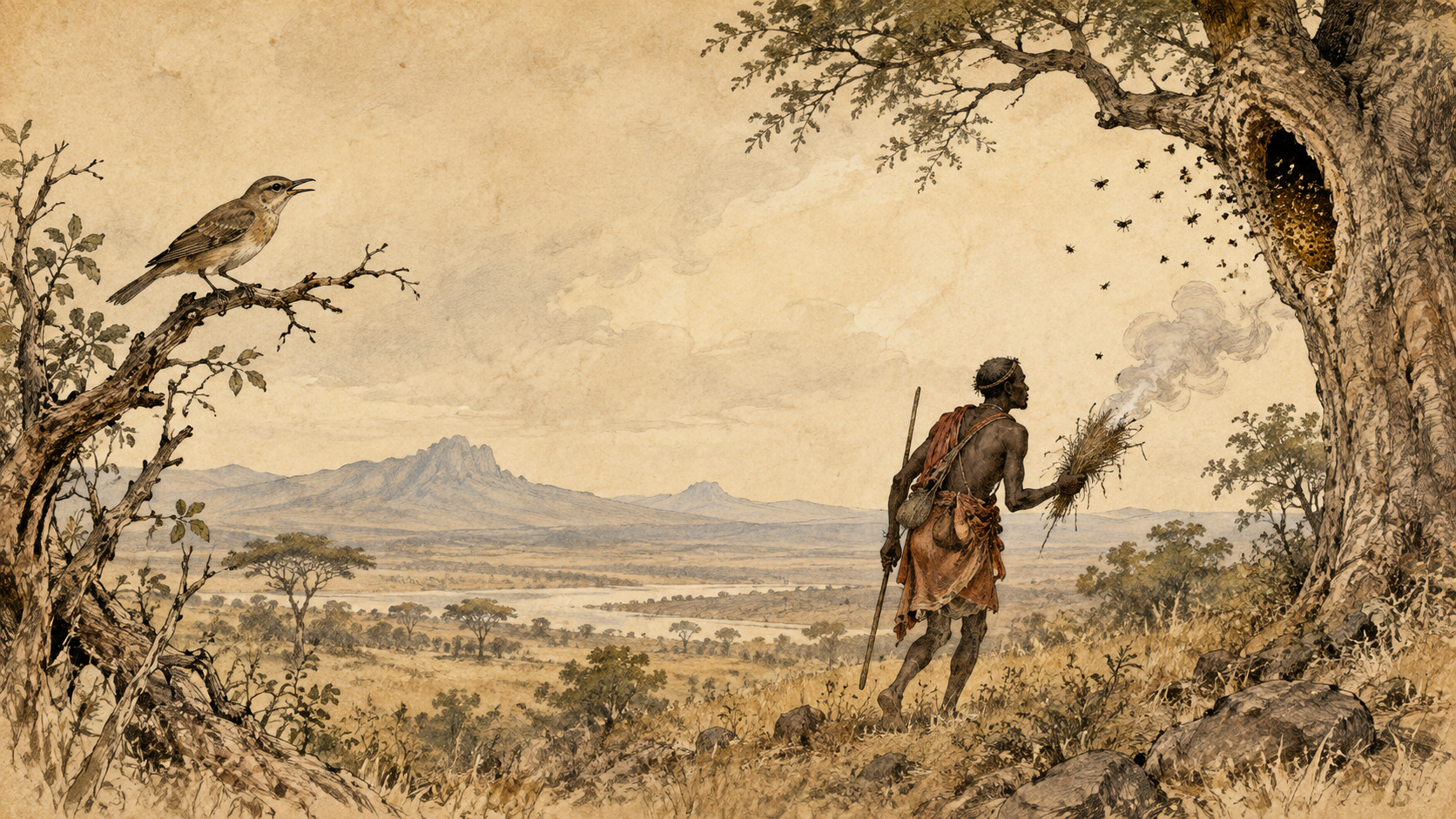
The greater honeyguide is a bird that can find wild honeybee colonies and can't open them. Honey-hunters can open them and can't find them. In northern Kenya, Hussein Isack counted 319 wild colonies and found that fewer than one in twenty had an opening a bird could use, while the bird's help cut a hunter's search time by nearly two-thirds. The bird's own reward is the wax. The chapter follows the partnership through three centuries of record. Andreas Sparrman described it for the Royal Society in 1777, David Livingstone tested the old story that the bird leads people to snakes by asking the 114 men in his party, and modern field teams have shown that honeyguides answer local calls, including the Yao "brrrr-hm." Isack also documents a partnership that fades where nobody answers the call anymore. The Civil War thread is a family story. Livingstone's son Robert enlisted in the 3rd New Hampshire Infantry under the name Rupert Vincent, was captured outside Richmond in October 1864, and died of wounds at the Confederate prison in Salisbury, North Carolina. His father never reached him, and the journal entries in the chapter show what Livingstone did with that. Casey reads the bird through John's Gospel: Philip's "Come and see," and the woman at the well who left her jar and pointed the town toward Jesus. The guide's part ends at the tree. What happens after is between the person and Christ, and for the people we can't reach, prayer is still an invitation we can extend.
Bee Science
- Wild colonies a honeyguide can't open
- in Isack's survey of 319 wild colonies in Marsabit district, northern Kenya, about two-thirds were in rock crevices, a little over a fifth in hollow trees, and the rest in termite mounds, ground holes, or (very rarely) in the open; only 4.3% had an opening wide enough for the bird to reach the comb
- Time to find a nest with the bird's help
- by Isack's count, the time it takes a honey-hunter to find a nest drops by 64% when a honeyguide is along
- The bird is after wax, not honey
- the greater honeyguide can digest beeswax, and eats wax, larvae and comb scraps left after people open a nest with fire and tools
- A call that works: the Yao "brrrr-hm"
- with the Yao honey-hunters' call, the chance of being guided rose from about one in three (33%) to two in three (66%), and the chance of reaching a bees' nest rose from 17% to 54%, compared with other sounds of similar loudness
- The birds answer the local call
- in Tanzania and Mozambique, honeyguides responded more readily to the local honey-hunters' call than to a foreign one, and sound transmission didn't explain the difference, so the birds appear to learn it
- A guide that never met its parents
- the greater honeyguide is a brood parasite, raised by other species, so it can't learn guiding from its own parents; the tendency to start the cooperation appears to be innate
- Led somewhere other than honey
- in northern Mozambique the bird led people to three snakes and one dead bushbaby, 3.7% of encounters in one year and none in the others; it didn't happen more often after an unrewarded hunt, and the best fit is a plain memory slip about where the bird was headed
- A partnership that fades without practice
- in Isack's interviews, 86% of Boran schoolchildren's encounters with the bird had happened while herding; by the end of the century, around Nairobi, Naivasha and Nakuru the birds no longer readily guided
Cited research (6)
- Isack (1999), Proceedings of the International Ornithological Congress: Boran honey-hunters of Marsabit district, Kenya: nest survey, search-time figure, calls, rewards, and the decline of guiding near towns
- Isack & Reyer (1989), Science 243: Analysis of guiding birds that confirmed the Boran hunters' reading of the bird's flight, calls and perch height (only the abstract's claim is used; notes flag the paper as not read in full)
- Spottiswoode, Begg & Begg (2016), Science 353: Playback experiment with the Yao "brrrr-hm" call in Niassa Special Reserve, Mozambique
- Spottiswoode & Wood (2023), Science 382: Honeyguides respond more readily to local calls than foreign ones in Tanzania and Mozambique
- van der Wal et al. (2022), Conservation Letters 15: Review of honeyguide biology: wax-eating, brood parasitism, and the evidence on honey badgers
- Lloyd-Jones, Muamedi & Spottiswoode (2025), Ecology and Evolution 15: Rate and likely cause of honeyguides leading people to things other than bees' nests
Scripture
Anchor: Romans 1:20
Also touches
Civil War Recordcivil war
Livingstone's Son Robert, a Union Soldier Who Never Reached His Father, 1863-1864
- David Livingstone wrote in his London journal on July 27, 1864: "Hear the sad news that Robert is in the American army" (Blaikie, The Personal Life of David Livingstone, 1880, p. 339)
- Robert, named for his maternal grandfather, the missionary Robert Moffat, had been sent to Natal to join his father but "found no opportunity of getting thence to the Zambesi," so he went to America and enlisted in the Union army at Boston under another name (Blaikie, 1880, p. 340)
- The 3rd New Hampshire Infantry's roll lists him as Rupert Vincent, Company H, born in South Africa, age 21, mustered in October 6, 1863 as a substitute for Horace D. Heath of Manchester, New Hampshire (Eldredge, The Third New Hampshire and All About It, 1893, p. 866); Blaikie says he died in his nineteenth year, so the two sources disagree on his age
- On October 7, 1864, Confederate troops attacked the regiment at daylight on the New Market Road outside Richmond; the regiment lost one man killed, eleven wounded and thirteen taken prisoner, and Vincent was among the captured (Eldredge, 1893, pp. 543-545, 866)
- He died of wounds on December 5, 1864 in the Confederate prison at Salisbury, North Carolina, and the regiment lists him among its dead buried there, not at Gettysburg where Blaikie's 1880 biography placed him (Eldredge, 1893, p. 1008; Blaikie, 1880, p. 340)
- Eldredge added: "It appears well authenticated that he was a son of Livingstone, the great African explorer. Died of wounds in a rebel prison" (Eldredge, 1893, p. 1023)
- On June 2, 1865, Livingstone wrote in his journal: "Robert we shall never hear of again in this world, I fear; but the Lord is merciful, and just, and right in all His ways. He would hear the cry for mercy in the hospital at Salisbury" (Blaikie, 1880, p. 355)
Primary sources (4)
- W. Garden Blaikie, The Personal Life of David Livingstone (1880), pp. 339-340, 348, 355
- Daniel Eldredge, The Third New Hampshire and All About It (1893), pp. 543-545, 866, 1008, 1023
- David Livingstone, Missionary Travels and Researches in South Africa (London: John Murray, 1857), pp. 344, 547
- Andreas Sparrman, Philosophical Transactions of the Royal Society 67 (1777), pp. 43-45
verified
From the Book
A guy at my church had bees in one of his trees. Getting them out was harder than it sounds. I tried a trap-out over two days, hoping to get the queen out. It didn't work. I ended up reaching into the tree and pulling the comb out a section at a time. Everybody watched. What's more interesting than a beekeeper who might get stung? Or might actually pull it off? Nobody was over my shoulder, but I knew they were back there. I felt like a potential train wreck with an audience. It worked out, though. I gave them a couple combs of honey afterward. Whoever points me to a tree like that has done the half of the job I can't. They know where the bees are. I know what to do about them. Neither one of us gets very far without the other. There's a bird in parts of Africa that lives by that arrangement.
Get the full book →