© 2026 Casey Spitnale
Chapter 11
The Bee Line
Finding the Way Home
“It taught me that even the insects in my path are not loafers, but have their special errands. Not merely and vaguely in this world, but in this hour, each is about its business.”
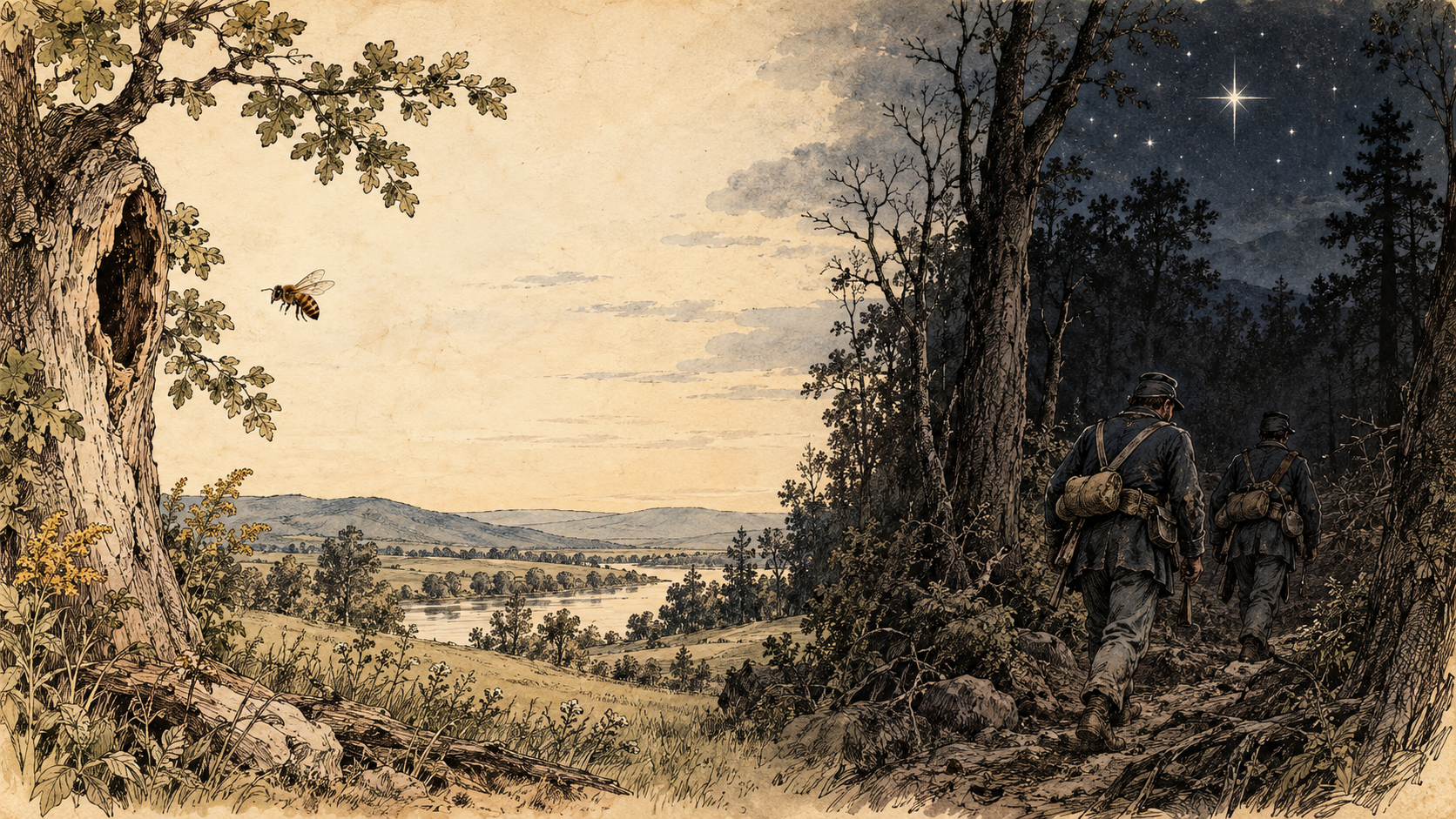
Honey bees are newcomers to this continent. They came by ship, escaped their hives, and kept going, so every bee tree in the Ohio woods traces back to a swarm that left somebody's hive in the east. Early writers from Paul Dudley to Thomas Jefferson noticed that the bees ran ahead of the settlers, and bee hunters learned to use that habit. The method is simple. A loaded forager circles a food source, then flies for home on a line close enough to straight that a hunter with a compass can walk it. Take two bearings from two spots and the tree is where the lines cross. Thoreau tried it in 1852 and wrote down what he saw, including a flight path that wavered and a hunt that never found a tree. The Civil War thread belongs to Williams County. William J. Knight of Stryker was one of the Andrews Raiders who tried to steal the locomotive General in 1862. After a jailbreak in Atlanta, he and W. W. Brown walked north by night toward the north star, hungry and hunted, and were fed and passed along by strangers who turned out to be loyal. Knight told the story for decades in township halls. Casey sets the chapter against Proverbs 3:5-6, and asks whether a straight path means an easy one. Four days to gain eight miles says no. Direction is a gift, and so is the help along the road. A forager shares hers on the comb, and Knight's rescuers shared theirs at a table. People can tell each other where they found help.
Bee Science
- Honey bees are not native to the United States
- the country has about 4,000 native bee species, but "there were no honey bees in America before European settlers brought hives from Europe"
- A loaded forager circles, then holds a near-straight course
- Thoreau watched a loaded bee circle the bait in widening loops (up to ten or twelve feet across) before heading off; her course stayed "within three or four feet of the same course for half a dozen rods," in a waving line rather than a perfectly straight one, and bees from one hive detoured around an apple tree
- A marked forager's round trip
- a bee dusted with red powder came back "In just twenty-two minutes"
- The two-bearing method for finding a wild colony
- release one fed bee and take its compass course, move about a third of a mile to one side ("an hundred Perch or Rod"), release a second and take that course; the tree stands where the two lines cross. Dudley called it a "Mathematical way of finding Honey in the Woods"
- One forager brings recruits
- Dudley noted that when one bee goes home from the sugar plate, "he returns with a considerable number from the Hive" (he meant she)
- Honey bees spread faster than settlers
- by 1811 bees were reported "as high up the Missouri as the Maha nation," having moved west "600 miles in 14 years"
Cited research (4)
- Moisset & Buchmann, Bee Basics, USDA Forest Service (2010), p. 1: Source for the count of native U.S. bee species and the statement that honey bees arrived with European settlers
- Dudley, Paul, Philosophical Transactions of the Royal Society (1721), p. 150: Earliest account in the chapter of the compass method for lining bees, and of foragers bringing nestmates back
- Thoreau, Journal, Sept. 30, 1852, in The Writings of Henry David Thoreau, vol. 10 (1906), pp. 368-373: A hunter's own record of the circling, the slightly wavering flight line, the 22-minute return, and the hunt that failed to find a tree
- Bartlett, John Russell, Dictionary of Americanisms (1848), p. 29: Defines "to take a bee-line" on the belief that loaded bees "always fly back to the hive in a direct line"
Scripture
Anchor: Romans 1:20
Also touches
Civil War Recordcivil war
William J. Knight of Stryker, Ohio: the Andrews Raid and a night walk home, 1862
- William J. Knight, born in Wayne County, Ohio in 1837, enlisted at Defiance in August 1861 in Company E of the 21st Ohio and in April 1862 was one of 24 men who followed James J. Andrews into Georgia to steal a train at Marietta; the engine was the General
- The raid failed and the raiders were captured; in August 1862 fourteen still held at Atlanta wrote to General Bragg asking whether mercy would be "misplaced," and the second name signed is "WM. KNIGHT" (Holt report, Official Records, ser. I, vol. 10, pt. 1, pp. 635-636)
- On October 16, 1862, the prisoners jumped the jailer when he came for the supper bucket and broke out; Knight, W. W. Brown and E. H. Mason went into the woods together, and Mason, sick, told the others to leave him
- Knight and Brown traveled by night toward the north star, crossed the Chattahoochee on October 26 "on rails tied together with bark," and by Knight's own account ate "only five meals in twenty-one days"; a family in a log house who saw through their cover story fed them and sent them on to friends, and they reached Somerset, Kentucky about November 25 and then their regiment at Nashville
- The Confederates flogged a young private, Jacob Parrott, more than a hundred lashes to make him name his comrades, "especially that of the engineer who had run the train," and he never did (Holt report, Official Records, ser. I, vol. 10, pt. 1, p. 631); E. H. Mason, left behind sick on the escape, was recaptured, per Holt's report
- Knight's Medal of Honor came in September 1863, and by the Medal of Honor Society's count nineteen of the twenty-four raiders received one (Congressional Medal of Honor Society, "William J. Knight," per notes/research/northwest-ohio-local-history.md); he toured with a lecture on the raid from 1878, and a seventeen-scene panorama painted by Albert Ruger in the 1880s went with him for more than eighteen years (now held by the Ohio History Connection); he settled in Stryker by 1886 and died there in 1916; a plaque honoring him was placed in the Williams County courthouse in Bryan in 2003
- Also in the chapter: Captain Charles W. Wills of the 103rd Illinois joined bee hunters at Griffin's Landing on October 2, 1863 (Army Life of an Illinois Soldier, 1906, p. 195); the Deseret News of August 5, 1863 reported the first swarms brought to Springville, Utah, one page after an editorial on Lee's retreat from Gettysburg
Primary sources (7)
- History of Defiance County (1883), pp. 322-324 (Knight's own account, as told to the county's historians)
- Joseph Holt, report of March 27, 1863, Official Records, ser. I, vol. 10, pt. 1, pp. 631-636
- William Pittenger, Capturing a Locomotive (1882)
- Bowersox, A Standard History of Williams County (1920), vols. I and II
- Wills, Army Life of an Illinois Soldier (1906), p. 195; Deseret News, Aug. 5, 1863, pp. 4-5
- Ohio Memory, "Knight Panorama" and "Andrews' Raid lecture broadside" (Ohio History Connection)
- notes/extraordinary-drafts/new-bee-line.md; notes/research/extraordinary-bees-in-america.md, extraordinary-bees-in-america-west.md, northwest-ohio-local-history.md, northwest-ohio-local-history-part2.md
verified
From the Book
One of my favorite things to do, during clean out or when I'm putting sugar water out, is lie down and watch the bee lines above me. You see right away which direction they go. Sometimes I move and watch to see if Marc's bees are invading, or if there's another hive somewhere close by with bees coming into the area. It's really easy to see the traffic. A loaded forager leaves a good food source and heads home. First she circles the spot. Then she flies away. For generations, people followed that line into the woods to find the tree she lived in. I can understand the temptation when I lie there watching the traffic. Where are they all going? A Williams County man's trip home gives me another reason to ask. The first thing to know about her is that she isn't from here. That one surprised me. The United States has about four thousand kinds of native bees: bumblebees, sweat bees, mason bees, and plenty more. But, as the USDA Forest Service's Bee Basics puts it, "there were no honey bees in America before European settlers brought hives from Europe." The honeybee in my backyard is an immigrant, the same as the apple tree.
Get the full book →