© 2026 Casey Spitnale
Chapter 9
The Guard Bee
Defending the Faith
“Cowardice is not an element of their nature; they fear no foe, and shrink from no danger.”
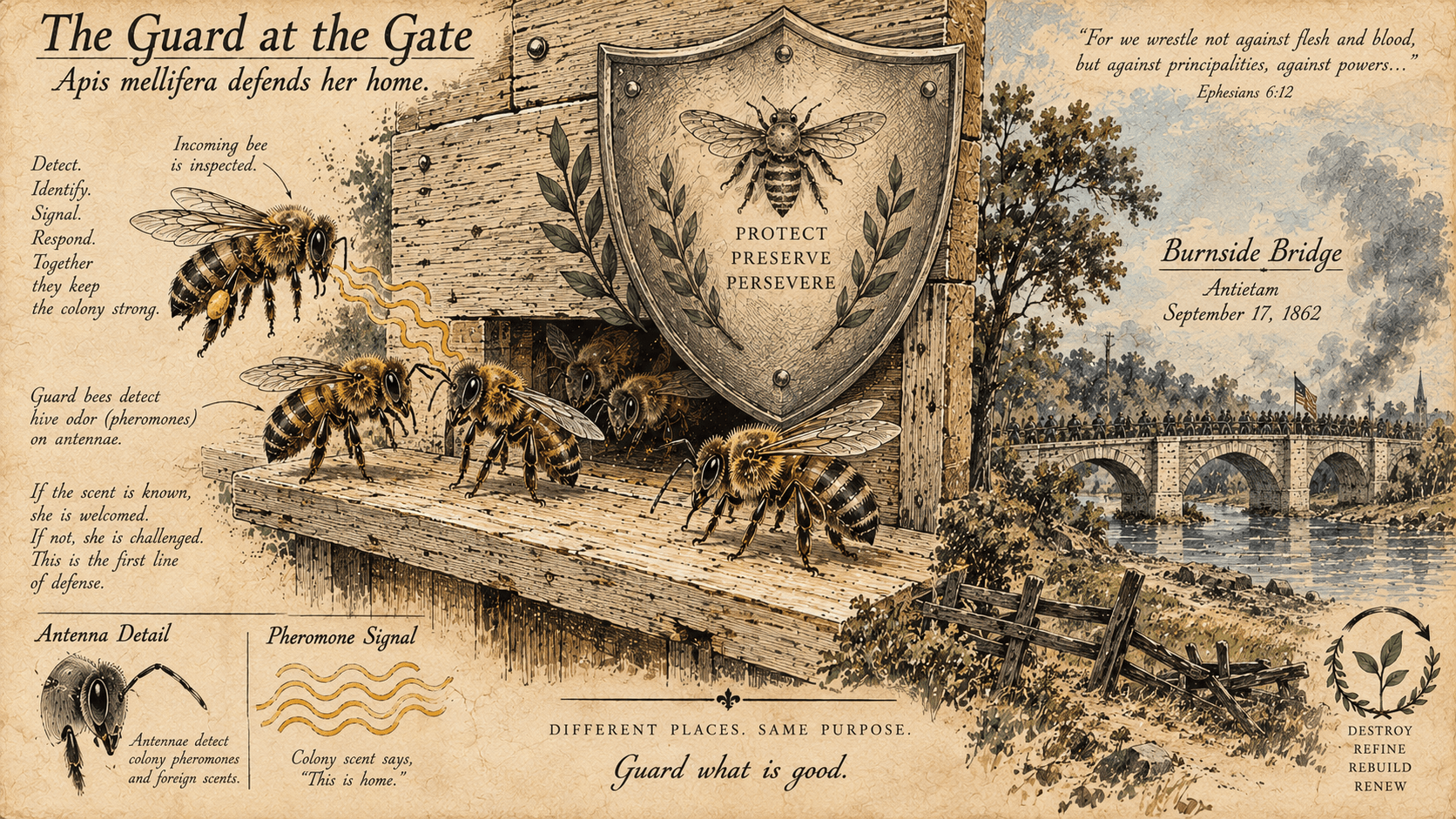
The chapter's throughline is that defense, done right, is discernment before it's force. A guard bee doesn't meet every visitor with the same fury: she reads scent and behavior first, and escalates only when the threat is real. That precision, not blind aggression, is what Casey holds up against Burnside Bridge, where a few hundred Georgia riflemen held a vastly larger Union corps for three hours, not because they meant to win the whole battle, but because the position was worth the cost of holding as long as they could. Ephesians 6:11 asks believers to "take your stand," not to charge. Casey reads that as the same posture: guarding what matters isn't about picking fights, it's about knowing what's worth defending and staying at the post once you've decided. The guard bee who lingers long enough on a strange comb to take on its scent doesn't stay a guest. She becomes part of what she's defending, which is Casey's read on Ephesians 2:19's promise that former strangers become fellow citizens with a post of their own. Casey also sets the guard bee's check beside a sentry's night challenge in an army camp, where the answer had to be the right word. A password can be lost or carried off by a deserter. A guard bee's countersign is the hive's own scent on her body, something she is rather than something she knows, and the question underneath is the same: who do you belong to? And guard duty doesn't clock out. Long after foragers have called it a night, some guards are still at the entrance, antennae up. Casey ties that to Psalm 121:4's watcher who neither slumbers nor sleeps: the kind of care that doesn't take breaks isn't incidental. It's the whole point.
Bee Science
- Onset of guard duty
- around day 17 of a worker's life, a distinct age-based task with its own window and a lot of individual variation in how long any one bee sticks with it
- Adoption window
- an intruder that lingers roughly two hours on the comb picks up the hive's own wax-and-food scent and stops being challenged; one such adopted intruder was seen guarding its new hive's entrance within 24 hours against members of its own parent colony
- Alarm pheromone
- isopentyl (isoamyl) acetate identified as the primary component of the sting pheromone that recruits nearby workers to defense
- Trained bee detectors
- bees conditioned via the proboscis-extension reflex (sugar water paired with a scent) were built into a three-bee explosives/narcotics detector, and a University of Montana project used tagged foragers to help locate buried land mines
- Alarm scent is its own brake
- the alarm scent rides on the sting, so it builds as more bees sting; stinging rises as the scent builds but drops back at very high concentrations, which researchers read as a way to limit how many workers the colony loses. This replaces an earlier, uncited attribution of the brake to separate "inhibitory pheromones"
- The examinee runs hot
- in infrared film of guards at work, the bee being checked ran warmer than the guard checking her; in checks lasting over 30 seconds, more than 60% of the examinees heated up by over 2°C (maximum 48.5°C, about 119°F) while most guards cooled. The authors suggest she heats up to strengthen her chemical signal (their explanation, not an observation)
- Guards notice, soldiers sting
- at nine colony entrances every guard was marked with a paint dot and a black suede flag was waved at the hive; about two guards in a hundred stung it. With guards pulled off the landing board beforehand, the colony gave about a third fewer stings (85 on average instead of 127). The bees that pour out to sting are mostly a separate group researchers call soldiers. Flag stands in for a large animal, not a robber bee
- Stinging is largely an individual habit
- defenders caught after a black feather was waved at the hive were tested four times against a spinning dummy; some stung every time, some never, both groups larger than chance predicts. Which bee it was mattered five times more than which colony she came from; alarm pheromone raised the odds without changing who was who, and mixing gentle bees with aggressive ones changed neither. An arena test with defenders, not guards at an entrance
- Recognition mistakes and a moving threshold
- returning foragers dabbed with a few millionths of a gram of one family of skin compounds (alkenes) were attacked harder by their own guards than bees given extra alkanes; through a shift from dearth to plenty, guards in the dearth accepted 80% of nestmates and 25% of strangers, then loosened until an accept-all threshold let every bee in
- Bees can learn human faces (honeybee, five bees)
- trained one at a time on photographs of faces and paid in sugar water, bees picked their face over a similar one better than eight times in ten in unrewarded tests, even against faces they had never seen; the authors do not claim to know how, and nobody has tested whether a bee knows her own beekeeper
Cited research (4)
- Moore, A.J., Breed, M.D., & Moor, M.J. (1987), "The Guard Honey Bee," Animal Behaviour 35:1159-1167: Established guarding as its own specialized task with a distinct age window and a lot of individual variation in duration — the well-documented mechanics (cuticular-hydrocarbon sampling, the raised-wing/open-mandible threat posture, graded response) are attributed to "work since then," not put in this one paper's mouth
- Boch, R., Shearer, D.A., & Stone, B.C. (1962), "Identification of Isoamyl Acetate as an Active Component in the Sting Pheromone of the Honey Bee," Nature 195:1018-1020: The paper that actually identified isopentyl (isoamyl) acetate as the alarm pheromone; replaced an unverifiable "Journal of Chemical Ecology, Volume 24, 1998" citation in the manuscript, 2026-09-09
- Stabentheiner, Kovac & Schmaranzer (2002); Arechavaleta-Velasco & Hunt (2003); Kannan, Galizia & Nouvian (2025); Dani et al. (2005); Downs & Ratnieks (2000); López-Incera et al. (2021): The 2026-09-23 additions on guard heat, guards versus soldiers, individual stinging habits, recognition errors, and the alarm-scent brake; see the bee_science facts above
- Butler, C.G. (1954), The World of the Honeybee: Colony-odour chapter (printed pp.144-151): guards appear mainly in late-summer dearth, alternate guard duty with foraging, and reject or admit intruders based on flight behavior and scent rather than smell alone
Scripture
Anchor: Romans 1:20
Also touches
Civil War Recordcivil war
The stand at Burnside Bridge, Antietam, September 17, 1862
- A detachment of the 2nd and 20th Georgia regiments (likely fewer than 400-550 rifles between them), under the on-scene command of Col. Henry L. Benning within Brig. Gen. Robert Toombs's brigade, held Burnside Bridge for roughly three hours against the Ninth Corps, numbering roughly 12,500 (Official Records, Series I, Volume 19, Part 1). The final manuscript names Brig. Gen. Jacob Cox as the Ninth Corps' commander, under Ambrose Burnside, who directed the army's left wing (manuscript ch.9 only; no research note covers the Cox detail)
- Lt. Col. William R. Holmes, commanding the 2nd Georgia, was killed defending the bridge; his after-action report was filed in his place by Capt. Abner Lewis. Col. John B. Cumming led the 20th Georgia beside them
- Pvt. Theodore T. Fogle of the 2nd Georgia left a letter, preserved in Emory University's manuscript collections, describing the retreat: the men fell back "only because our ammunition was exhausted"
- The Georgians withdrew in order, not by annihilation, once Union troops crossed downstream at Snavely's Ford and turned their flank; the two regiments lost something like a third of their engaged numbers between them — real and costly, but far short of the destruction an earlier, fabricated draft of this chapter had claimed
- Gen. James Longstreet's memoir credits the delay with giving Confederate reinforcements under Gen. A.P. Hill time to march the seventeen miles from Harper's Ferry and strike the Union flank as it began to break through
- After Gettysburg, a Union soldier was found in a secluded spot on the field, where, wounded, he had laid himself down to die, with nothing on him to say who he was and a picture of three small children "tightly clasped" in his hands. Dr. J. Francis Bourns of Philadelphia had copies made and gave the story to the papers; a woman in western New York who had not heard from her husband since the battle recognized the picture, and Bourns's copy was "the first news that she had that her children were fatherless." He was Sgt. Amos Humiston of the 154th New York (Frank Moore, Anecdotes, Poetry and Incidents of the War, 1866, p. 321; Edward P. Smith, Incidents of the United States Christian Commission, 1869, pp. 175-176; notes/research/extraordinary-myths-and-science-2-cognition.md, verified)
- Not Civil War, used as the ancient lineage of putting bees in the doorway: Aeneas Tacticus (c. 350 BC) on releasing wasps and bees into enemy mines; the defenders of Themiscyra shoving bears and bee swarms into Roman siege tunnels (Appian, The Mithridatic Wars); the Irish annals' account of Chester's defenders dropping "all the beehives in the town" on Norse attackers early in the 900s, which rests on a single late chronicle and is held loosely (notes/research/extraordinary-old-world-history.md, items 2a to 2c)
Primary sources (6)
- Official Records of the Union and Confederate Armies, Series I, Volume 19, Part 1 (Toombs's and Benning's reports)
- Stephen W. Sears, Landscape Turned Red: The Battle of Antietam (Ticknor & Fields, 1983)
- Pvt. Theodore T. Fogle's letter, Emory University manuscript collections
- Gen. James Longstreet, From Manassas to Appomattox (1896)
- Frank Moore, Anecdotes, Poetry and Incidents of the War (1866); Edward P. Smith, Incidents of the United States Christian Commission (1869)
- Aeneas Tacticus, On the Defence of Fortified Positions (trans. Illinois Greek Club, 1923); Appian, The Mithridatic Wars (trans. Horace White, 1912); Annals of Ireland: Three Fragments (ed. O'Donovan, 1860)
verified
From the Book
Around day 17, some workers begin guarding the hive entrance. They check visitors with their antennae. A bee coming through that door has to get past them first. I found out how seriously they take that job during an early inspection. I rushed and didn't use enough smoke. One well-placed sting got my attention. I still remember it. Protective instinct runs all through creation, and a guard bee is one of the plainest cases of it. For those few days, their bodies stay oriented toward approaching visitors, antennae extended to sample the air. They can tell the difference between returning foragers who belong to their colony and potential intruders through subtle chemical signatures. When they detect a threat, they release alarm pheromones. More defenders come to the entrance. Wasps, robber bees, and larger animals can all draw a response. Defending the colony can cost a guard her life. They stand between the colony and everything that wants what's in it. The queen, the brood, and the honey are all behind them.
Get the full book →